Last Updated on May 9, 2026 by Bharat
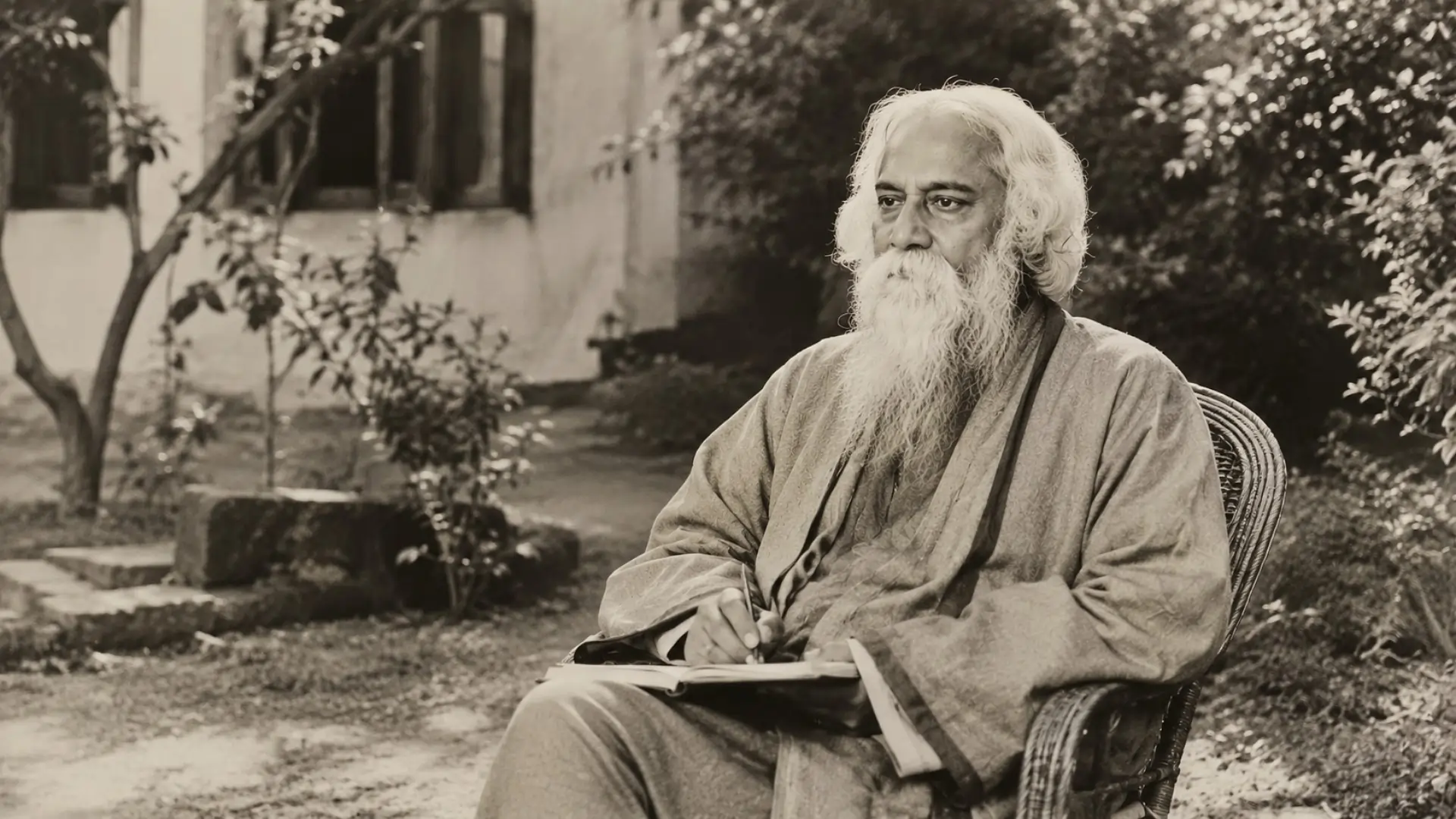
Rabindranath Tagore (1861-1941) was a renowned Indian poet and writer, who was called the Bard of Bengal. He was a man of many talents and contributed to the development of Bengali literature and music during the late 19th and early 20th centuries. He is best known for winning the 1913 Nobel Prize in Literature for Gitanjali, and writing the national anthems for both India and Bangladesh.
Rabindranth Tagore: Key Facts at a Glance
| Fact | Detail |
| Full Name | Rabindranath Tagore |
| Also Known as | Bard of Bengal |
| Born | May 7, 1861, Jorasako Thakurbari, Kolkata |
| Died | August 7, 1941, Jorasako Thakurbari, Kolkata |
| Famous Work | Gitanjali |
| Major Award | Nobel Prize in Literature (1913) |
| Key Legacy | Founder of Visva-Bharati University |
Why was Rabindranath Tagore so famous?
Rabindranath Tagore was a man of many talents who revolutionized the thinking of people about art. He composed poems, songs, stories, and plays in a new style that abandoned the old style. He spoke in simple terms, in a way that was accessible to everyone. This made him popular among the general public as well as scholars.
Tagore wrote around 2,200 songs during his life. These songs came to be known as Rabindra Sangeet. They are still sung today during weddings, festivals and ceremonies throughout the world by Bengali speaking people. His creations struck a chord with people because of their simple way of expressing complex human emotions.
Why did he win the Nobel Prize in Literature?
In 1913 Tagore was awarded the Nobel Prize in Literature for his collection of poems, Gitanjali. He was the first lyricist and a non-European to have received this honour. His work earned the praise of the prize committee for its rich beauty and freshness in style.
Tagore was introduced to the West by the famous Irish poet, W.B. Yeats. He was the one who wrote the introduction for the English version of Gitanjali. In this book, Indian spiritual ideas were explained to the rest of the world in a way that was modern and relatable. The English version of Gitanjali was the one for which Tagore was awarded the Nobel Prize.
How did his work shape national identities?
Rabindranath Tagore was the author of “Jana Gana Mana” which was adopted as the national anthem of India. He also wrote “Amar Shonar Bangla”, which became the national anthem of Bangladesh. These songs united people and became a part of their national identity.
Tagore famously took a stand against British rule in 1919. He returned his knighthood following the events of Jalliwanwala Bagh Massacre. This was a title of honour given to him by the British monarchs. He gave it back, thereby demonstrating to the world that he was on the side of his people in the fight against injustice.
What was his vision for modern education?
Tagore was not fond of conventional schools which kept the children within the four walls. He believed that children should learn by being more close to nature. To demonstrate this, he established his own university called ‘Visva-Bharati University’ in 1921 at a place in Santiniketan which went on to become a renowned centre for the arts and literature.
The students of the university studied under trees. He was interested in blending the best of both Eastern traditions with the scientific developments of the West.
Rabindranath Tagore remains a giant of global culture. His poems and songs continue to inspire people to seek peace and beauty in their daily lives.
Rabindranath Tagore is a central figure in Bengali literature and enjoys a massive following. His poems and songs still motivate people to find peace and beauty in their everyday lives.