Last Updated on July 7, 2026 by Gaurav
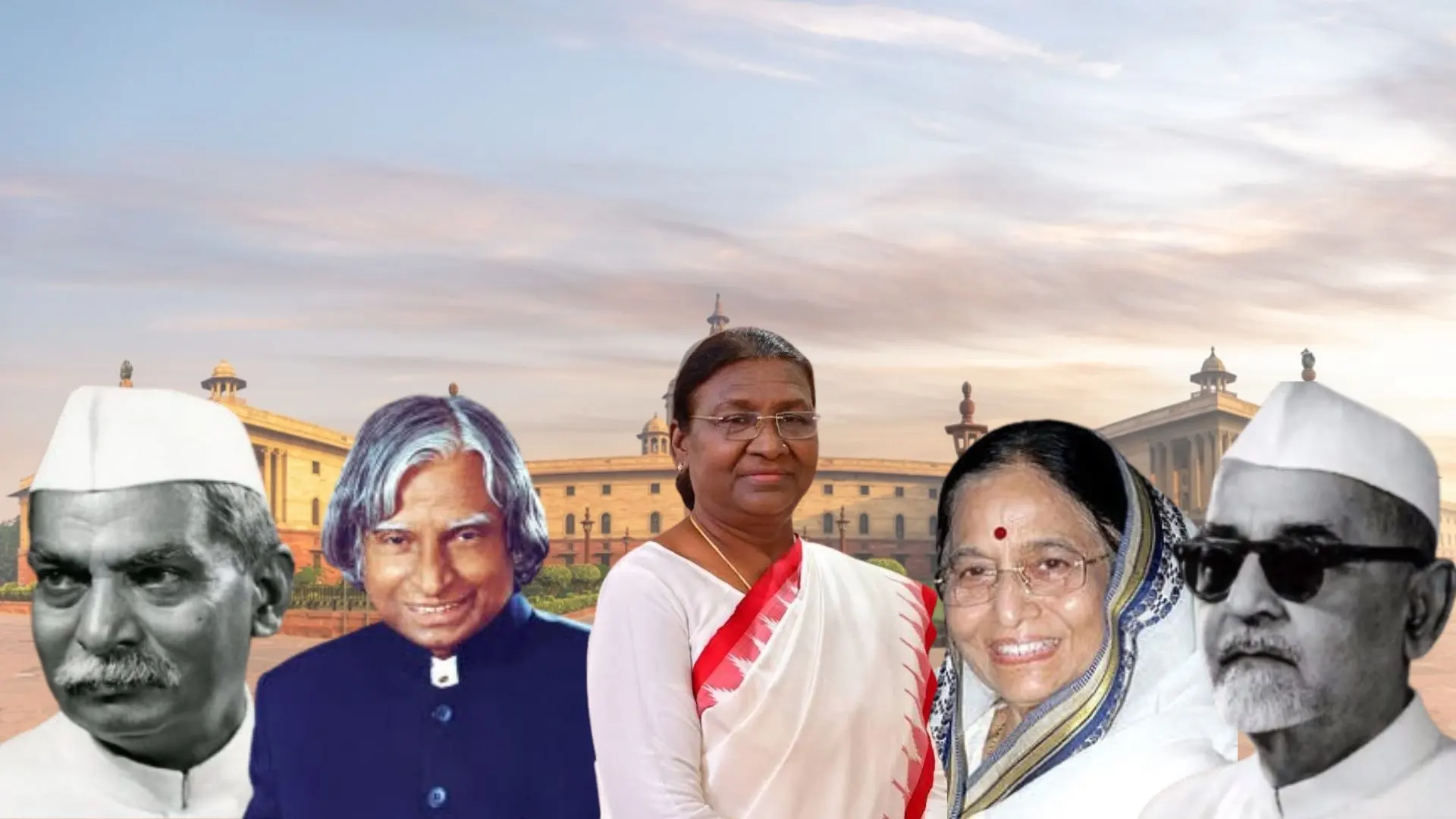
India is a land of great leaders, rich history, and a democracy that the whole world looks up to. Since becoming a Republic on 26 January 1950, India has been guided by a series of remarkable individuals who have held the highest constitutional office in the country, the President of India.
Whether you are a student preparing for exams, a general knowledge enthusiast, or simply someone who loves learning about India, this article is for you. Here is the complete list of all Presidents of India from 1947 to the present day, along with key facts and highlights about each one of them.
When India got independence on 15 August 1947, the country was still a dominion under the British Crown. India had a Governor-General representing the King during this transitional period. It was only when the Constitution of India came into force on 26 January 1950 that India became a republic, and the office of the President of India was formally created.
Since 1950, India has had 15 Presidents in total, beginning with Dr. Rajendra Prasad, who also had the longest tenure.
READ| Article 356 of the Indian Constitution
What Does the President of India Do?
Before we look at the list, let us understand the role briefly.
The President of India is the head of state of the Republic of India and the Supreme Commander of the Indian Armed Forces. The President is referred to as the First Citizen of India. Although vested with these powers by the Constitution, the position is largely ceremonial, and executive powers are in practice exercised by the Prime Minister.
The President is elected by the Electoral College, which is composed of elected members of the Rajya Sabha, the Lok Sabha, and the Vidhan Sabhas of all states. The term of office is five years.
READ| List of Chief Ministers of All States in India
List of Presidents of India (1950 – Present)
| Name | Tenure |
| Smt. Droupadi Murmu | July 25, 2022 – Incumbent |
| Shri Ram Nath Kovind | July 25, 2017 – July 25, 2022 |
| Shri Pranab Mukherjee | July 25, 2012 – July 25, 2017 |
| Smt. Pratibha Devisingh Patil | July 25, 2007 – July 25, 2012 |
| Dr. A.P.J. Abdul Kalam | July 25, 2002 – July 25, 2007 |
| K.R. Narayanan | July 25, 1997 – July 25, 2002 |
| Dr Shankar Dayal Sharma | July 25, 1992 – July 25, 1997 |
| R. Venkataraman | July 25, 1987 – July 25, 1992 |
| Giani Zail Singh | July 25, 1982 – July 25, 1987 |
| Neelam Sanjiva Reddy | July 25, 1977 – July 25, 1982 |
| B.D. Jatti | February 11, 1977 – July 25, 1977 |
| Fakhruddin Ali Ahmed | August 24, 1974 – February 11, 1977 |
| Varahagiri Venkatagiri | August 24, 1969 – August 24, 1974 |
| Justice Mohammad Hidayatullah | July 20, 1969 – August 24, 1969 |
| Varahagiri Venkatagiri | May 03, 1969 – July 20, 1969 |
| Dr Zakir Hussain | May 13, 1967 – May 03, 1969 |
| Dr Sarvepalli Radhakrishnan | May 13, 1962 – May 13, 1967 |
| Dr Rajendra Prasad | January 26, 1950 – May 13, 1962 |
1. Dr. Rajendra Prasad (1950 to 1962)
Dr. Rajendra Prasad holds a very special place in Indian history. He was the first President of India and the only President to serve two full terms.
Born in Bihar on 3 December 1884, he was a close associate of Mahatma Gandhi and played a vital role in India’s freedom movement.
His simplicity, humility, and dedication to the nation made him one of the most loved figures in Indian political history. His two-term record remains unmatched till date.
2. Dr. Sarvepalli Radhakrishnan (1962 to 1967)
Dr. Sarvepalli Radhakrishnan was a renowned philosopher and scholar who previously served as India’s Vice President. His presidency enhanced India’s intellectual reputation worldwide.
He was not just a statesman but one of the greatest teachers India has ever produced. His birthday, 5 September, is celebrated as Teachers’ Day in India in recognition of his contribution to education. He was awarded the Bharat Ratna in 1954.
Dr. Radhakrishnan represented India in the best possible light on the world stage, blending Eastern philosophy with Western academics in a way that earned India enormous respect globally.
3. Dr. Zakir Husain (1967 to 1969)
Dr. Zakir Husain was the first Muslim President of India. He was a renowned educationist and was awarded the Bharat Ratna in 1963.
He co-founded Jamia Millia Islamia University and is remembered for his commitment to modern education. Throughout his life, he fought for communal harmony and national integration, making him a unifying figure in a diverse nation.
Acting Presidents in 1969
After the passing of Dr. Zakir Husain, there was a brief period managed by two Acting Presidents.
V. V. Giri, who was the Vice President at the time, became Acting President on 3 May 1969. He later resigned to contest the Presidential election. After his resignation, Justice Mohammad Hidayatullah, the then Chief Justice of India, served as Acting President from 20 July 1969 to 24 August 1969.
V. V. Giri remains the only person in Indian history to have held office both as a President and as an Acting President.
4. V. V. Giri (1969 to 1974)
Varahagiri Venkata Giri, commonly known as V. V. Giri had a remarkable journey to the highest office. He was the only President of India to be elected as an independent candidate.
Known for his strong association with the labour movement, he championed workers’ rights and trade union activities in India. He was a firm believer in the rights of the working class and worked tirelessly for their welfare long before becoming President.
5. Fakhruddin Ali Ahmed (1974 to 1977)
Fakhruddin Ali Ahmed was the fifth President of India and is primarily remembered for declaring the Emergency under Article 352. He signed the proclamation of the Emergency on the advice of the then Prime Minister Indira Gandhi in 1975, a period that is considered one of the most controversial chapters in India’s democratic history.
After his death, B. D. Jatti served as Acting President from 11 February 1977 to 25 July 1977.
6. Neelam Sanjiva Reddy (1977 to 1982)
Neelam Sanjiva Reddy became the sixth President of India after the Emergency period ended and a new government came to power. He was a politician from Andhra Pradesh with a long and distinguished career in Indian politics.
He was the only President of India to be elected unopposed. No other candidate was fielded against him, making his election a unique moment in Indian presidential history.
7. Giani Zail Singh (1982 to 1987)
Giani Zail Singh was the first Sikh President of India. He was a prominent Congress leader from Punjab and had served as the Chief Minister of Punjab before becoming the Home Minister of India.
His tenure was marked by some of the most turbulent events in modern Indian history, including Operation Blue Star in 1984.
8. R. Venkataraman (1987 to 1992)
Ramaswamy Venkataraman, fondly known as R. Venkataraman, was a lawyer, freedom fighter, and veteran politician from Tamil Nadu. He had served in important roles including Finance Minister and Defence Minister before becoming President.
His tenure as President was a period when India saw political changes, including the rise of coalition politics. He administered the oath of office to multiple Prime Ministers during his term. He was known for his calm and steady approach to the constitutional duties of the office.
9. Dr. Shankar Dayal Sharma (1992 to 1997)
Dr. Shankar Dayal Sharma was a distinguished statesman and lawyer from Madhya Pradesh. Before becoming President, he had served as the Vice President of India, Governor of several states, and held important positions in the Congress party.
He presided over a very significant period in Indian history, one that included the liberalisation of the Indian economy in 1991 and its aftermath, and major social changes.
10. K. R. Narayanan (1997 to 2002)
K. R. Narayanan was a trailblazer in every sense. He was the first Dalit President of India, coming from a humble background in Kerala. His journey from a small village in Kerala to the highest constitutional office of India is nothing short of inspiring.
11. Dr. A. P. J. Abdul Kalam (2002 to 2007)
If there is one President who truly captured the hearts of every Indian, it was Dr. A. P. J. Abdul Kalam. Known as the “Missile Man of India” and the “People’s President,” Dr. Kalam was unlike any President before him.
He was a scientist and the first scientist to become President. He played an important role in India’s nuclear tests and inspired millions through his speeches and books.
12. Pratibha Patil (2007 to 2012)
Pratibha Patil created history by becoming the first woman President of India. Prior to her election as President, she served as the Governor of Rajasthan from 2004 to 2007, also becoming the first woman to hold that position.
She made history by becoming the first woman head of state to fly a Sukhoi fighter jet in 2009. This was a moment that captured the imagination of the entire country and showed that the Indian Air Force and the President’s office together could create inspiring moments.
13. Pranab Mukherjee (2012 to 2017)
Pranab Mukherjee was one of the most experienced politicians in the history of independent India. Often called the “Man for All Seasons” in Indian politics, he had served as Finance Minister, External Affairs Minister, Defence Minister, and Commerce Minister at various points in his long career.
14. Ram Nath Kovind (2017 to 2022)
Ram Nath Kovind was a lawyer and former politician from Uttar Pradesh who had also served as the Governor of Bihar before becoming President. He was the second Dalit President of India after K. R. Narayanan.
His tenure saw some major events including the abrogation of Article 370 in Jammu and Kashmir, the COVID-19 pandemic, and the Ram Mandir verdict. He continued to advocate for social justice and education throughout his term.
15. Droupadi Murmu (2022 to Present)
Tenure: 25 July 2022 to Present
Droupadi Murmu is the current President of India, the youngest person to hold the office, and the first President from a tribal community.
She was sworn in as the 15th President of India on 25 July 2022. Previously, she served as the Governor of Jharkhand from 2015 to 2021. She has devoted her life to empowering the downtrodden and marginalised sections of society.
She is the second female President of India, after Pratibha Patil, and the first tribal woman to hold this office.
What Makes the Indian Presidency Unique?
Looking at the list of all 15 Presidents, one thing stands out clearly. India’s Presidency has always reflected the diversity and inclusive spirit of the nation. From scholars and philosophers like Dr. Radhakrishnan to scientists like Dr. Kalam, from the first Dalit President K. R. Narayanan to the first tribal President Droupadi Murmu, each President has added a new chapter to India’s democratic story.
India’s Presidents have been a mirror of the nation itself, diverse, learned, rooted in values, and committed to the Constitution. From the founding years of the Republic to the present day, each President has contributed to making India’s democracy stronger and more representative.
READ| List of Prime Ministers of India (1947 – Present)
For more such well-researched GK articles helpful for exam aspirants and general readers seeking authentic and up-to-date coverage of current affairs, history, polity, science, technology, economy, sports, and beyond, keep exploring various categories of GKinfoBuzz, your trusted resource for knowledge and information.