
Last Updated on May 17, 2026 by Gaurav
Every country in the world has a national animal. Germany has the eagle. Australia has kangaroos. China has the giant panda.
But India? India chose something different. Something that is not just an animal. It is a symbol. It is a warning. It is a story that goes back more than 4,000 years.
Most people think they know the answer to this question. Some say lion. Some say elephant. Some even say peacock.
But the real answer is something that once roamed freely across almost every forest in this country. An animal so powerful that kings feared it. So beautiful that gods chose it as their vehicle. And so important that the Government of India had to launch an emergency programme just to save it from disappearing forever. Do you know which animal we are talking about?
Let’s find out what is the national animal of India.
READ| India to Host 1st IBCA Summit in June 2026
What is the National Animal of India?
Source: Jim Corbett National Park
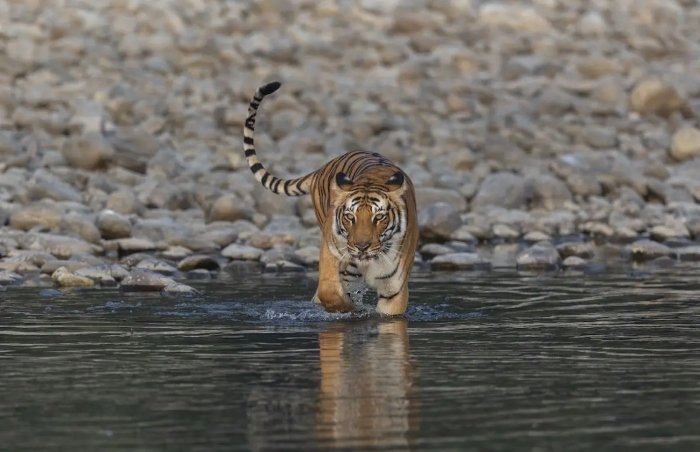
The national animal of India is the Royal Bengal Tiger. Its scientific name is Panthera tigris tigris.
It was declared the national animal in 1973, replacing the lion. It was chosen to represent India’s rich wildlife heritage and the country’s commitment to conservation.
The Royal Bengal Tiger was formally given this title on November 18, 1972. After this, on April 1, 1973, the Government of India launched Project Tiger. It was started from Jim Corbett National Park in Uttarakhand and it changed the future of tigers in India forever.
The Royal Bengal Tiger is the largest wild cat in the world. It has a bright orange coat with black stripes and a white belly. Its stripes range from dark brown to black and the tail is orange with black rings.
Here is something that will surprise you. Every single tiger in the world has a different stripe pattern. No two tigers are the same. It is exactly like how every human being has different fingerprints. Nature made sure each tiger had its own unique identity.
The tiger is also deeply connected to Indian religion and culture. In Hindu mythology, the tiger is closely associated with Goddess Durga, who is often shown riding a tiger. This represents strength, courage, and the victory of good over evil.
The tiger also appears on the Pashupati seal of the Indus Valley Civilisation. This means Indians have respected this animal for more than 4,000 years. Long before India became a country, the tiger was already a part of who we are.
The India Government website states: “The magnificent tiger, Panthera tigris is a striped animal. It has a thick yellow coat of fur with dark stripes. The combination of grace, strength, agility and enormous power has earned the tiger its pride of place as the national animal of India. Out of eight races of the species known, the Indian race, the Royal Bengal Tiger, is found throughout the country except in the north-western region and also in the neighbouring countries, Nepal, Bhutan and Bangladesh. To check the dwindling population of tigers in India, ‘Project Tiger’ was launched in April 1973. So far, 27 tiger reserves have been established in the country under this project, covering an area of 37,761 sq km.”
Why Was Tiger Chosen As the National Animal of India Over Lion?
Source: Adobe
This is the question that confuses most people. India’s national emblem shows four lions. The Ashoka Pillar has lions on it. Even the Reserve Bank of India uses the lion symbol. So why is the tiger our national animal and not the lion?
The reason is simpler than you think. While the lion symbolized courage and royalty, its presence in India was limited to the Gir forests of Gujarat only. The tiger, on the other hand, lived across the entire country, from the Sundarbans mangroves to the Himalayan foothills. This made the tiger a much stronger symbol of India’s biodiversity.
But there was another reason too. In the early 1970s, continuous hunting and habitat destruction had caused a major fall in tiger numbers, raising alarm across the world.
Tigers were being killed for their skin and bones. Forests were being cut down. India was about to lose its tigers forever.
Declaring the tiger as the national animal gave the government both the reason and the responsibility to act immediately. On April 1, 1973, the Government of India launched Project Tiger which is a conservation programme focused on protecting habitats, stopping poaching, and monitoring tiger populations regularly.
Where Does the Royal Bengal Tiger Live in India?
One of the most amazing things about the Royal Bengal Tiger is that it does not need just one type of forest. It can live in many different kinds of places. No other big cat in the world does this. Here are the most famous tiger habitats in India:
Jim Corbett National Park, Uttarakhand This is India’s oldest national park. Corbett Tiger Reserve has 260 tigers, the highest number in any single reserve in the whole country.
Ranthambore National Park, Rajasthan One of the most visited tiger reserves in India. Tigers here are more used to human presence, so sightings are more common. Many tourists plan their entire trip around seeing a tiger here.
Bandhavgarh Tiger Reserve, Madhya Pradesh One of the highest tiger densities in the country. Wildlife photographers from across India and abroad come here specifically to photograph tigers in the wild.
Sundarbans, West Bengal The only place in the entire world where tigers live in mangrove forests and swim in saltwater. These tigers have adapted to a completely different lifestyle than tigers anywhere else on Earth.
Kanha Tiger Reserve, Madhya Pradesh Said to be the inspiration behind Rudyard Kipling’s famous story, The Jungle Book. One of the most beautiful wildlife destinations in all of Asia.
What Are Interesting Facts About the Royal Bengal Tiger?
Here are some facts about Royal Bengal Tigers:
1. Tigers Love Water Most cats hate getting wet. Tigers are completely different. They love swimming. The tigers of the Sundarbans regularly swim across wide rivers to hunt. Water is no challenge for them at all.
2. Their Hearing Is Far Better Than Any Human Tigers can hear sounds up to 60 kHz, far beyond what any human ear can detect.
3. India Ran the Biggest Wildlife Survey in the World India’s 2023 tiger census used over 26,000 camera traps across 20 states. This is one of the largest wildlife surveys ever conducted anywhere on the planet. The scale of this effort shows how seriously India takes the protection of its national animal.
4. Nagpur is called the Tiger Capital of India Nagpur is known as the Tiger Capital of India because it sits right in the middle of some of the biggest tiger reserves in the country, including Tadoba, Pench, and Bor.
5. A Tiger’s Roar Can Be Heard From 3 Kilometres Away When a tiger roars, the sound travels up to 3 km in every direction.
The national animal of India is not just a name you write in an exam and forget. It is an animal that has been with us for more than 4,000 years. It sits on ancient coins, rides with our goddesses, and lives in our forests from the mountains to the sea.








👏🏻👏🏻