Last Updated on May 15, 2026 by Parikshit
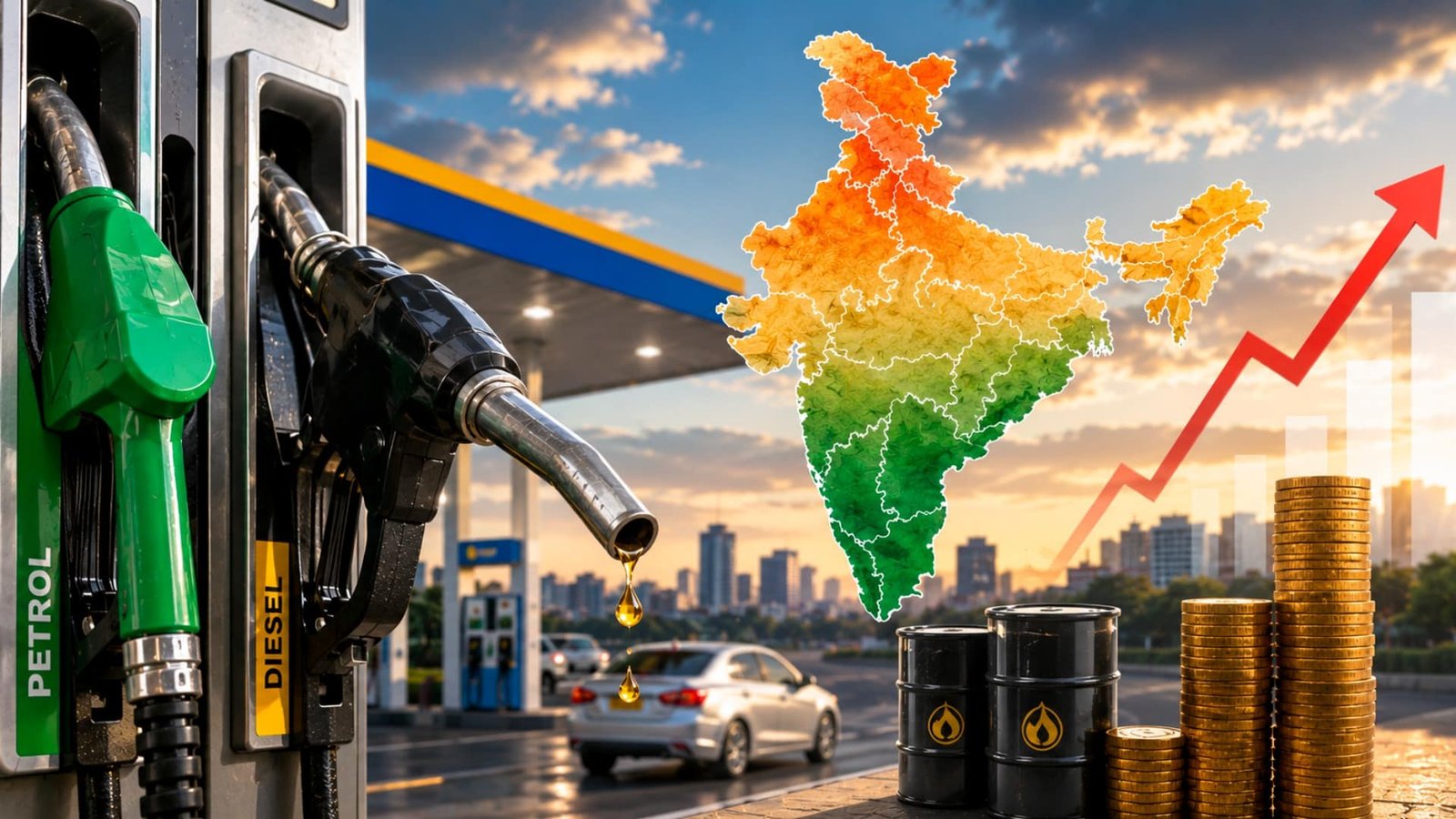
Fuel prices in India have increased once again, bringing fresh concern for daily commuters, transport operators, and households across the country. Petrol and diesel prices were revised on May 15, 2026, with oil marketing companies raising rates by nearly ₹3 per litre in most states and union territories. The latest revision comes amid rising global crude oil prices and geopolitical tensions in West Asia.
If you are planning to visit a petrol pump today, it is important to check the updated rates in your city and state before refuelling your vehicle.
Why Did Petrol and Diesel Prices Increase Across India Today?
State-owned oil companies revised the retail prices of petrol and diesel on May 15, 2026. In Delhi, petrol prices increased from ₹94.77 to ₹97.77 per litre, while diesel rose from ₹87.67 to ₹90.67 per litre. Similar increases were reported across metro cities and other states.
The fuel price hike is the first major nationwide revision in nearly four years. Reports suggest that oil companies were facing heavy financial pressure due to the sharp rise in international crude oil prices. Brent crude recently crossed the $105–$120 per barrel range amid tensions around the Strait of Hormuz and the ongoing West Asia crisis.
Statewise Petrol Prices in India in May 2026
| State / Union Territory | Petrol Price (₹/Litre) | Increase (₹) |
| Andaman & Nicobar | 84.99 | 2.53 |
| Andhra Pradesh | 113.03 | 3.29 |
| Arunachal Pradesh | 93.88 | 3.21 |
| Assam | 101.21 | 2.97 |
| Bihar | 108.55 | 3.01 |
| Chandigarh | 97.27 | 2.97 |
| Chhattisgarh | 103.56 | 3.11 |
| Dadra and Nagar Haveli and Daman and Diu | 95.33 | 2.89 |
| Delhi | 97.77 | 3.00 |
| Goa | 99.76 | 3.19 |
| Gujarat | 97.95 | 3.35 |
| Haryana | 98.95 | 3.00 |
| Himachal Pradesh | 98.31 | 2.93 |
| Jammu & Kashmir | 99.83 | 3.34 |
| Jharkhand | 100.84 | 2.98 |
| Karnataka | 106.21 | 3.25 |
| Kerala | 110.58 | 3.20 |
| Ladakh | 106.05 | 2.88 |
| Lakshadweep | 103.51 | 2.76 |
| Madhya Pradesh | 109.71 | 3.30 |
| Maharashtra | 106.68 | 3.14 |
| Manipur | 102.28 | 3.13 |
| Meghalaya | 98.86 | 2.60 |
| Mizoram | 102.11 | 2.56 |
| Nagaland | 99.97 | 2.28 |
| Odisha | 104.19 | 3.22 |
| Puducherry | 99.25 | 2.99 |
| Punjab | 101.19 | 2.90 |
| Rajasthan | 107.97 | 2.94 |
| Sikkim | 106.50 | 3.05 |
| Tamil Nadu | 103.67 | 2.87 |
| Telangana | 110.89 | 3.39 |
| Tripura | 100.61 | 3.08 |
| Uttar Pradesh | 97.55 | 2.82 |
| Uttarakhand | 96.23 | 2.68 |
| West Bengal | 108.70 | 3.25 |
Statewise Diesel Prices in India in May 2026
| State / Union Territory | Diesel Price (₹/Litre) | Increase (₹) |
| Andaman & Nicobar | 80.64 | 2.59 |
| Andhra Pradesh | 100.71 | 3.14 |
| Arunachal Pradesh | 83.28 | 3.06 |
| Assam | 92.50 | 3.04 |
| Bihar | 94.63 | 2.85 |
| Chandigarh | 85.25 | 2.80 |
| Chhattisgarh | 96.55 | 3.16 |
| Dadra and Nagar Haveli and Daman and Diu | 90.91 | 2.97 |
| Delhi | 90.67 | 3.00 |
| Goa | 91.49 | 3.16 |
| Gujarat | 93.73 | 3.46 |
| Haryana | 91.41 | 3.01 |
| Himachal Pradesh | 90.28 | 3.04 |
| Jammu & Kashmir | 88.52 | 3.19 |
| Jharkhand | 95.76 | 3.14 |
| Karnataka | 94.10 | 3.11 |
| Kerala | 99.35 | 3.09 |
| Ladakh | 90.95 | 2.73 |
| Lakshadweep | 98.54 | 2.83 |
| Madhya Pradesh | 94.88 | 3.08 |
| Maharashtra | 93.14 | 3.11 |
| Manipur | 88.15 | 2.92 |
| Meghalaya | 90.12 | 2.40 |
| Mizoram | 90.80 | 2.22 |
| Nagaland | 91.36 | 2.54 |
| Odisha | 95.74 | 3.19 |
| Puducherry | 89.39 | 2.92 |
| Punjab | 90.97 | 2.88 |
| Rajasthan | 93.23 | 2.74 |
| Sikkim | 93.40 | 2.85 |
| Tamil Nadu | 95.25 | 2.86 |
| Telangana | 98.96 | 3.26 |
| Tripura | 89.50 | 2.95 |
| Uttar Pradesh | 90.82 | 2.96 |
| Uttarakhand | 91.35 | 2.91 |
| West Bengal | 95.13 | 3.11 |
Why Have Fuel Prices Increased in India?
The main reason behind the fuel price increase is the surge in global crude oil prices. India imports nearly 85% of its crude oil requirement, making domestic fuel prices highly sensitive to international developments.
Recent tensions in West Asia, especially around the Strait of Hormuz, disrupted global oil supply chains and pushed Brent crude oil above $105 per barrel. Oil marketing companies including Indian Oil Corporation (IOC), Bharat Petroleum (BPCL), and Hindustan Petroleum (HPCL) were reportedly facing major losses on fuel sales before the latest price revision.
Why Do Petrol and Diesel Prices Differ From State to State?
Even though the fuel hike was announced nationwide, the final prices still vary between states. This happens because every state imposes different Value Added Tax (VAT) rates on petrol and diesel. Transportation costs, dealer commissions, and local levies also affect the final retail price.
For example, petrol prices in Telangana and Andhra Pradesh are significantly higher than Delhi due to higher state taxes and additional charges. Meanwhile, some union territories maintain comparatively lower prices because of lower VAT structures.
Impact of Fuel Price Hike on Common People
The latest increase in petrol and diesel prices is expected to affect transportation costs, food delivery services, logistics, and daily commuting expenses. Experts believe the rise may also push inflation slightly higher in the coming weeks, especially in sectors dependent on road transport.
Many consumers are now expected to shift towards fuel-efficient vehicles, public transport, and electric mobility options to reduce their monthly fuel expenses.
The nationwide fuel price revision in May 2026 has added extra financial pressure on consumers across India. Petrol and diesel rates have increased by around ₹3 per litre in most states, mainly due to rising international crude oil prices and geopolitical instability in West Asia.
Before visiting a fuel station, consumers are advised to check the latest city-wise fuel prices, as rates continue to differ across states because of varying local taxes and transportation charges.