Last Updated on June 27, 2026 by Gaurav
India got its independence in 1947 and it took the country 3 years to become a democracy on 26 January 1950. Since then the country has been run by governments that are ruled by different parties over the years.
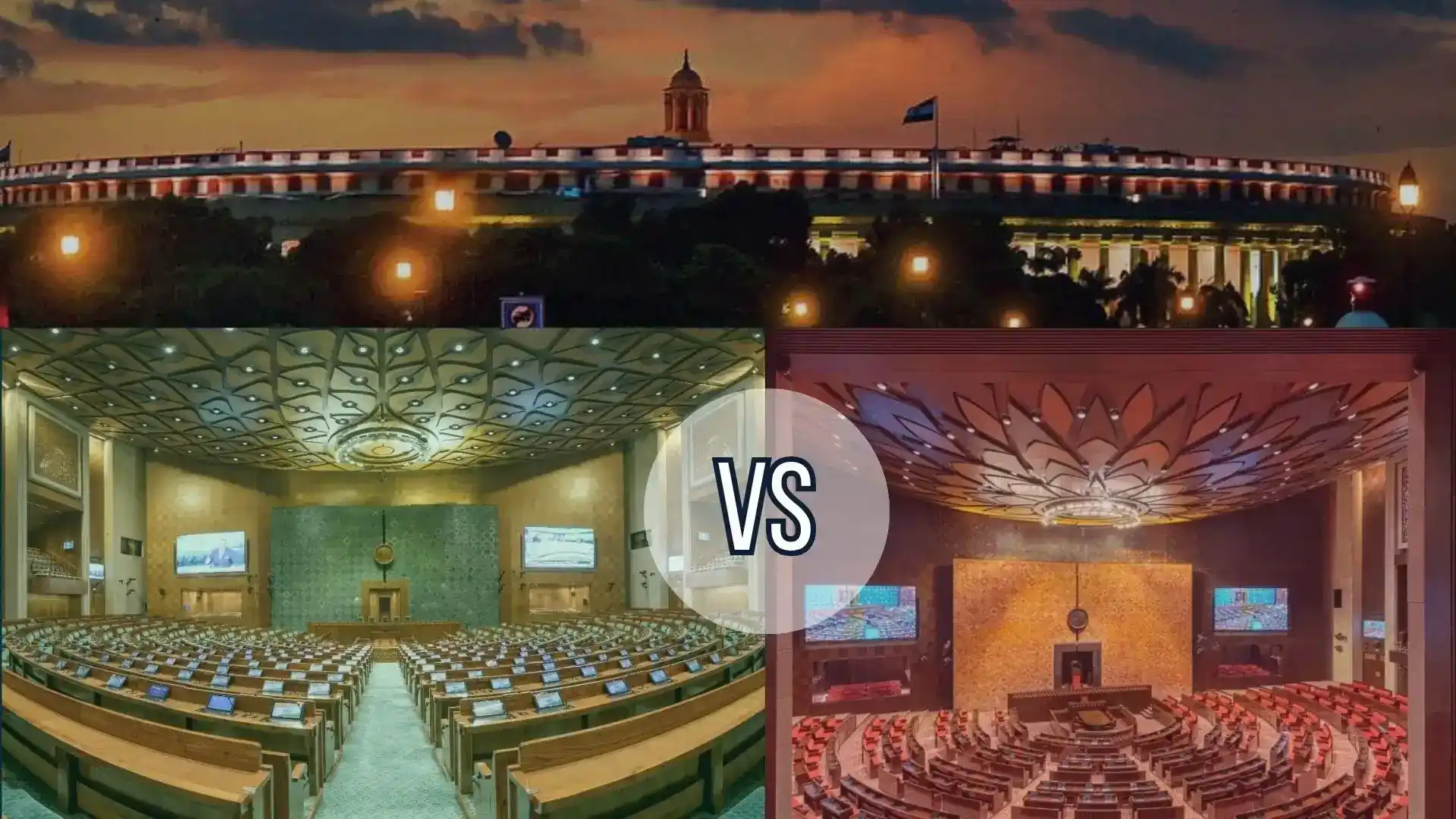
Being an independent nation since 1950, India’s parliament has two major houses which are Lok Sabha and Rajya Sabha. These houses are in place to make laws for the nation. Moreover, they are a direct voice of the people in the government.
These two houses work for the welfare of the nation however, both houses are very different from each other in how they are formed, who sits in them, how long they last, and what powers they have. Let’s understand what are the differences between Lok Sabha and Rajya Sabha.
Key Differences Between Lok Sabha and Rajya Sabha
| Difference | Lok Sabha | Rajya Sabha |
| Full Name | House of the People | Council of States |
| Type | Lower House | Upper House |
| Maximum Seats | 550 | 250 |
| Elected By | Directly by citizens | Indirectly by MLAs of State Assemblies |
| Term of Members | 5 years | 6 years |
| Can It Be Dissolved? | Yes | No (permanent body) |
| No-Confidence Motion | Can pass it and remove government | Cannot pass it |
| Represents | People of India | States and Union Territories |
| Constitutional Article | Article 81 | Article 80 |
Test Your Knowledge
Question: How many members of Rajya Sabha are nominated by the President?
A) 15
B) 12
C) 19
D) 30
Answer: B) 12
What is Lok Sabha?
The Lok Sabha is also known as the lower house of Parliament. This house is responsible for making and passing laws as well as financial matters since all money bills are introduced in Lok Sabha.
The members of the Lok Sabha are chosen by people through votes. As of now, there are a total of 530 seats in this house which consists of 530 from different states across India and 20 from Union Territories.
The India Gov website states: “The Lok Sabha, India’s lower house of Parliament, comprises representatives elected by direct vote based on universal adult suffrage. The Constitution permits up to 550 members: 530 from the States and 20 from Union Territories.”
The total number of elected members of Lok Sabha was reduced to 550 due to the 104th Constitutional Amendment of 2019. Earlier there were 552 seats which gave provision for nominated Anglo-Indian members but now it doesn’t exist. This house is called House of the People.
| Did you Know? The minimum number of Lok Sabha members required to hold a Lok Sabha session is 55 which is only 10% of the total strength. |
What is the Rajya Sabha?
The Rajya Sabha is the Upper House of the Indian Parliament. The basic concept of Rajya Sabha is to represent the interests of individual states and territories and it acts as a governing body that checks the laws passed by the Lok Sabha so as to ensure they are not unfair.
The Rajya Sabha can’t be dissolved as it is a permanent House. According to Sansad website, the total members of Rajya Sabha are 250. Out of these 250 members, 12 are appointed by the President and the rest 238 represent the states and the Union Territories of India.
Unlike the Lok Sabha, the members of Rajya Sabha are not elected by the public. There is a different system where the elected Members of the Legislative Assemblies (MLAs) elect the members with the single transferable vote system. The full name of Rajya Sabha is the Council of States.
| Did You Know? The name Rajya Sabha for the Council of States was introduced in 1954. On 23 August, 1954 the Chairman of the Council of States announced that the House will now be called Rajya Sabha in Hindi. |
How Many Seats Are There in Lok Sabha?
There are a total of 550 seats in Lok Sabha and currently there are 542 elected members in Lok Sabha as of 2026. Here is a party-wise representation of all the members of Lok Sabha
| Party | Number of Members |
| Bharatiya Janata Party (BJP) | 240 |
| Indian National Congress (INC) | 98 |
| Samajwadi Party (SP) | 37 |
| All India Trinamool Congress (AITC) | 28 |
| Dravida Munnetra Kazhagam (DMK) | 22 |
| Telugu Desam Party (TDP) | 16 |
| Janata Dal (United) | 12 |
| Shiv Sena (Uddhav Balasaheb Thackrey) | 9 |
| Nationalist Congress Party – Sharadchandra Pawar | 8 |
Source: Sansad
How Many Seats Are There in Rajya Sabha?
The Article 80 of the Constitution of India defines the maximum strength of the Rajya Sabha to be 250 and 12 of the members are chosen by the President of India. The current strength of Rajya Sabha is 245. Here is the party-wise representation of Rajya Sabha members.
| Party | Number of Members |
| Bharatiya Janata Party | 115 |
| Indian National Congress | 28 |
| All India Trinamool Congress | 10 |
| Dravida Munnetra Kazhagam | 8 |
| Nominated | 7 |
| Biju Janata Dal | 5 |
| All India Anna Dravida Munnetra Kazagham | 4 |
| Independent and Others | 4 |
| Janata Dal (United) | 4 |
| Nationalist Congress Party | 4 |
| Samajwadi Party | 4 |
| Telugu Desam Party | 4 |
| Yuvajana Sramika Rythu Congress Party | 4 |
| Aam Aadmi Party | 3 |
| Bharat Rashtra Samithi | 3 |
| Communist Party of India | 3 |
| J&K National Conference | 3 |
| Jharkhand Mukti Morcha | 3 |
| Rashtriya Janata Dal | 3 |
| Communist Party of India | 2 |
| Indian Union Muslim League | 2 |
| Shiv Sena | 2 |
| UNITED PEOPLES PARTY (LIBERAL) | 2 |
| Asom Gana Parishad | 1 |
| Bahujan Samaj Party | 1 |
| Desiya Murpokku Dravida Kazhagam | 1 |
| Janasena Party | 1 |
| Janata Dal (Secular) | 1 |
| Kerala Congress (M) | 1 |
| Makal Needhi Maiam | 1 |
| Mizo National Front | 1 |
| National Peoples Party | 1 |
| Nationalist Congress Party – SHARADCHANDRA PAWAR | 1 |
| Pattali Makkal Katchi | 1 |
| Rashtriya Lok Dal | 1 |
| Rashtriya Lok Morcha | 1 |
| Republican Party of India (ATHAWALE) | 1 |
| Shiv Sena-Uddhav Balasaheb Thackeray | 1 |
Test Your Knowledge
Question: Who was the first Chairman of Rajya Sabha?
A) Dr. S. Radhakrishnan
B) Dr. Zakir Husain
C) Dr. Rajendra Prasad
D) G.S. Pathak
Answer: A) Dr. S. Radhakrishnan
Can Lok Sabha and Rajya Sabha Get Dissolved?
Yes, the Lok Sabha can dissolve and this is one of the most significant differences between the two Houses.
As per the Constitution of India Article 83(2), the Lok Sabha can be dissolved after the completion of five years from the first of its meeting. This simply means that the life of a Lok Sabha is only 5 years and a new House is again established after the general elections.
On the other hand, Rajya Sabha can never be dissolved. The Rajya Sabha continues to work even after the dissolution of the Lok Sabha so that there is stability in Parliament.
Who Do They Represent?
The Lok Sabha is dedicated to represent people of India as a whole. On the other hand Rajya Sabha represents the states and union territories of India.
No-Confidence Motion
The Rajya Sabha cannot remove the Council of Ministers by passing a no-confidence motion. On the other hand, if the Lok Sabha does not trust the government, it can pass a no-confidence motion and bring the government down. The Rajya Sabha simply does not have this power.
| Did You Know? Balram Jakhar is the longest serving Speaker of Lok Sabha. He served for a total of 9 years and 329 days. |
What Are the Special Powers of Rajya Sabha?
Lok Sabha might be powerful in many aspects however, the Rajya Sabha has been given certain powers that are exclusive and Lok Sabha has no access to them. Here is a simple breakdown:
- Rajya Sabha can authorise the Parliament so that it can make a law based on subjects that are in interest of a particular state as per (Article 249).
- It can authorise the Parliament to establish new All-India Services like IAS as per Article 312.
- It can act on its own to remove the Vice-President. The condition is that a resolution to remove the Vice-President may only be submitted in the Rajya Sabha and not in the Lok Sabha as per Article 67.
- If an emergency situation in the nation arises and the Lok Sabha is dissolved or is going to dissolve within the emergency period then the Rajya Sabha can act alone.
What is the Difference Between an MP of Lok Sabha and Rajya Sabha?
Both are Members of Parliament (MPs), but they come from very different backgrounds and are chosen in completely different ways.
A Lok Sabha MP is directly elected by ordinary citizens of the country. They represent a specific geographic area and are accountable directly to the voters who have elected them. Their term is 5 years.
A Rajya Sabha MP is elected by the MLAs (Members of the State Legislative Assembly) of their state, and not ordinary citizens. They represent the state as a complete entity in Parliament. Their term lasts 6 years.
Who Sits in Rajya Sabha? MP or MLA?
This is a very common point of confusion. Here is the clear answer:
Rajya Sabha members are MPs (Members of Parliament) and not MLAs (Members of Legislative Assembly).
An MLA (Member of Legislative Assembly) represents the legislative assembly at the state level, while an MP (Member of Parliament) represents the legislative body at the national level.
However, the members of the Rajya Sabha are elected by the MLAs of various states. Members of a state’s Legislative Assembly (MLAs) vote in the Rajya Sabha elections through a dedicated vote system.
So in simple words: MLAs vote to send MPs to the Rajya Sabha. The MLAs do not sit in Rajya Sabha themselves which means they only vote to elect who goes there.
A person cannot be an MLA and an MP at the same time. As per the Representation of People Act, 1951, if a person is elected to both Parliament and State Legislature then they need to resign from one before they can sit in the other.
Why Does India Have Two Houses?
The Rajya Sabha is there so as to maintain a federal balance. It protects the interests of the states and also ensures that the states carry a voice in the national decision-making process. Further, the Rajya Sabha acts as a check on the power of the Lok Sabha.
In short, the Lok Sabha speaks for the people, and the Rajya Sabha speaks for the states. Both are needed to pass a law, which ensures every part of the country has a say.
For more such well-researched GK articles helpful for exam aspirants and general readers seeking authentic and up-to-date coverage of current affairs, history, polity, science, technology, economy, sports, and beyond, keep exploring various categories of GKinfoBuzz, your trusted resource for knowledge and information.