Last Updated on May 21, 2026 by Bharat
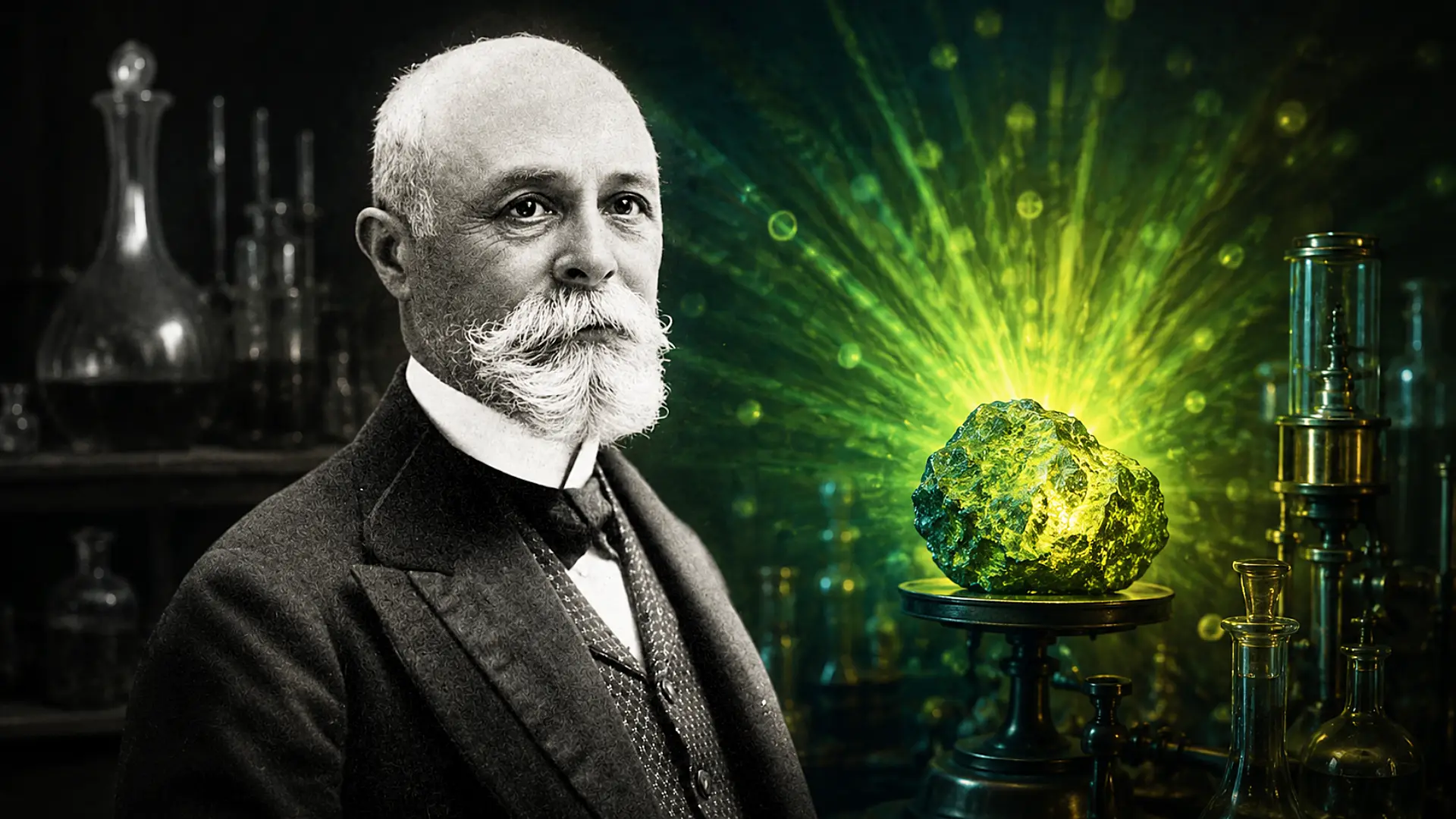
The question of who discovered radioactivity will lead us to the year 1896, when the French physicist Henri Becquerel accidentally discovered the phenomenon. Although he was the first one to see the effect, further expansions in the field was conducted by Marie Curie and her husband Pierre Curie. Let us explore how radioactivity was discovered, the scientists behind the discovery and why the discovery is important for mankind.
Radioactivity was discovered in 1896 by Henri Becquerel. He discovered that uranium salts gave off rays which could penetrate thick paper and fog photographic plates. This work was later extended by Marie Curie and Pierre Curie.
Marie Curie was the first to use the term “radioactivity”. She and her husband Piere Curie discovered the radioactive elements polonium and radium. In 1903, all three were awarded the Nobel Prize in Physics for discovering the phenomenon of radioactivity.
Discovery of Radioactivity: Key Facts at a Glance
| Feature | Details |
| Primary Discoverer | Henri Becquerel |
| Year of Discovery | 1896 |
| Material Used | Uranium salts (Potassium uranyl sulfate) |
| Term Coined By | Marie Curie (in 1898) |
| Key Elements Found | Uranium, Polonium, Radium |
| Nobel Prize Year | 1903 (Physics) |
How was radioactivity discovered in 1896?
Henri Becquerel discovered radioactivity when he was investigating phosphorescent materials to see if they emitted X-rays. Phosphorescence is a process where a substance glows after being exposed to light.
In February 1896, Becquerel put uranium salts on photographic plates wrapped in black paper. He was going to take them out into the sun. But for a couple of days the weather in Paris remained cloudy. Becquerel put the plates and the uranium in a dark drawer.
He developed the plates on March 1, regardless. He was looking for a faint picture. Rather, the pictures were very distinct and vivid. Henri Becquerel’s discovery was an accident and it was a discovery that uranium emitted energy without the external source like the sun.
What was the role of Marie and Pierre Curie?
The work of Marie and Pierre Curie is important to understand why radioactivity became a major field of study. They started to study the “uranium rays” discovered by Becquerel in 1896.
At that time, Marie Curie was a doctoral student. She invented a machine called an electrometer, which she used to measure the small electrical currents in the air that are caused by uranium rays. This is called ionization. Ionization is the process of atoms gaining or losing electrons to become electrically charged.
Her research resulted in three significant findings:
1. She proved that the strength of the radiation depended only on the amount of uranium present.
2. She named this property of the matter as radioactivity.
3. She found other elements such as thorium to be radioactive too.
In 1898, Marie and Pierre Curie discovered two new radioactive elements. The first one was named Polonium, after Marie’s native country of Poland. The second was Radium, because of its ability to emit powerful rays. These discoveries led to two of them being awarded the Nobel Prize in Physics in 1903, along with Becquerel.
Why is the discovery of radioactivity significant?
This discovery changed the world mainly because it demonstrated that atoms are not solid and indestructible spheres. Radioactivity demonstrated the ability of atoms to break down or decay which released a tremendous amount of energy contained within the nucleus.
The protons and neutrons are located in the center of the atom, in the nucleus. An unstable nucleus emits radiation. The concept resulted in the creation of atomic weapons and nuclear power.
Radioactivity was also used in medicine to treat cancer. Radiation therapy is a technique used by doctors to destroy cancer cells. It also provided the facility for carbon dating. Carbon dating is a way of figuring out how old organic matter is by measuring the radioactive decay of the material.
Who is known as the Father of Radioactivity?
Henri Becquerel is regarded as the father of radioactivity since he was the first person to observe the phenomenon in 1896.
Why did Henri Becquerel win the Nobel Prize?
In 1903 Becquerel was awarded the Nobel Prize in Physics “in recognition of the extraordinary services he has rendered by his discovery of spontaneous radioactivity. He shared the prize with Marie and Pierre Curie.
What did Marie Curie discover exactly?
Marie Curie discovered radioactivity is an atomic property. She found two new elements, polonium and radium. During World War 1, she also created mobile X-ray units, and she was the first to receive two Nobel Prizes in two different science categories.
Is radioactivity natural or man-made?
Radioactivity is a natural phenomenon. It is found in rocks, soil and even in the human body. But scientists can also produce man-made radioactivity in the laboratory using particle accelerators.
What are the examples of radioactive elements?
The examples of radioactive elements include Uranium, Radium, Cobalt-60, and Carbon-14.