Last Updated on July 13, 2026 by Parikshit
The Constitution of India is the supreme law of the nation, which was established to make India a sovereign, socialist, secular, democratic republic.
During the adoption of the Indian Constitution, there were 8 schedules. But, after the various amendments to the Indian Constitution, it increased to 12. Currently, there are 12 schedules in the Indian Constitution.
So, let’s explore the complete list of schedules of the Indian Constitution with their related articles in detail.
Schedules Of Indian Constitution
The Indian Constitution was adopted by the Constituent Assembly on 26th November 1949 and came into force on 26th January 1950. Originally, the Indian Constitution adopted only 8 schedules, but it is now expanded to 12 schedules in the Indian Constitution through various amendments.
What Are The Main Objectives Of The Schedules In The Indian Constitution?
The Schedule is a very essential part of the Constitution of India which simply enhances document functions where articles of the Indian Constitution get conflicts.
The main objectives of the schedule in the Indian Constitution are the following:
- To Simplify the Legal Complexity: All the schedules of the Indian Constitution are given in a simple and straight structure, which is easy to understand.
- The schedule acts as a reference: All 12 of these schedules are used as references for clarification of any provision of the articles in the Indian Constitution.
- It also facilitates the amendment: If any amendment is required for any update in the article, then there is no need to rewrite the entire article. Instead of this, a specific section can be updated or amended using these schedules of the Indian Constitution.
List Of 12 Schedules With Their Features & Related Articles
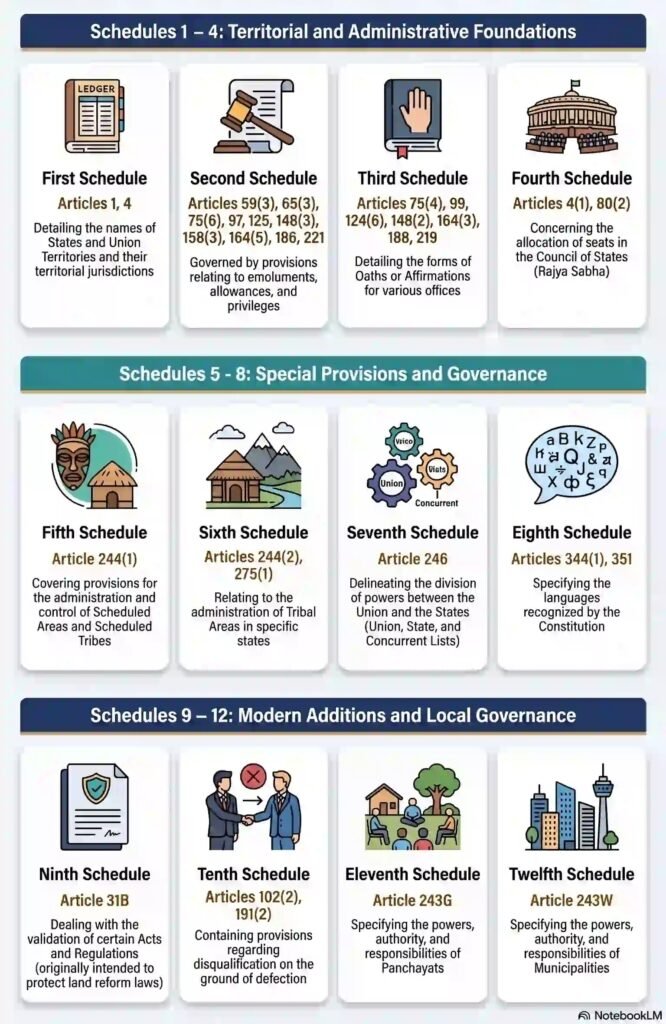
All the 12 schedules of the Indian Constitution have their own provisions and significance, which deal with different aspects of Indian governance. Here all the 12 schedules are given below in the table format with their features and related articles.
| Schedule | Feature | Related Articles |
| First Schedule | List of States and Territories of India | Articles 1 and 4 |
| Second Schedule | Provisions for salary, allowance, and enumeration of officials holding public office that are: 1. The President of India 2. State Governors 3. Lok Sabha Speaker & Deputy Speaker 4. Rajya Sabha Chairman & Deputy Chairman 5. Legislative Assembly Speaker and Deputy Speaker (State) 6. Legislative Council Chairman & Deputy Chairman (State) 7. Judges of Supreme Court & High Court 8. Comptroller and Auditor General of India | Articles 59(3), 65(3), 75(6), 97, 125, 148(3), 158(3), 164(5), 186 and 221 |
| Third Schedule | It contains the forms of oath and affirmation for: Union & State Minister Parliament Election Candidates Members of Parliament Judges of Supreme Court & High Court Comptroller and Auditor General of India State Legislature Election Candidate State Legislature Members’ | Articles 75(4), 99, 124(6), 148(2), 164(3), 188 and 219 |
| Fourth Schedule | It contains the provision for the allocation of the seat for the Rajya Sabha (Council of State) in every state and union territory based on the population. | Articles 4(1) and 80(2) |
| Fifth Schedule | It contains the provision to deal with the control and administration of schedule areas and schedule tribes in all Indian states. | Article 244(1) |
| Sixth Schedule | It contains provisions for the administration of tribal areas in the four northeastern states of India, which are: Assam, Meghalaya, Tripura, Mizoram | Articles 244(2) and 275(1) |
| Seventh Schedule | This includes three lists which help in determining the legislative authority over different subject matters, and these three lists are: 1. Union List: Total 100 Subjects 2. State List: Total 61 Subjects 3. Concurrent List: Total 52 Subjects | Article 246 |
| Eighth Schedule | It deals with the 22 official languages recognised by the Constitution of India, which are: Assamese Bengali Bodo Dogri Gujarati Hindi Kannada Kashmiri Konkani Maithili Malayalam Manipuri Marathi Nepali Odia Punjabi Sanskrit Santhali Sindhi Tamil Telugu Urdu | Articles 344(1) and 351 |
| Ninth Schedule | This provision contains laws exempted from judicial scrutiny, which is primarily aimed at land reform and socio-economic justice. Note: This schedule was added by the 1st Constitutional Amendment Act in 1951. | Article 31B |
| Tenth Schedule | This schedule contains the provision of disqualification of the Members of Parliament and State Legislature on the ground of defection. Note: This schedule was added by 52nd Constitutional Amendment Act in 1951. This schedule is also known as the “Anti-Defection Law” | Articles 102(2) and 191(2) |
| Eleventh Schedule | It contains the provision that defines the functions, power, and responsibilities of the Panchayati Raj institution. Under this schedule, there are a total of 29 functional items to deal with under rural local government. Note: This schedule was added by the 73rd Constitutional Amendment Act in 1992. | Article 243G |
| Twelfth Schedule | It contains the provision that defines the functions, power, and responsibilities of the Municipalities. Under this schedule, there are a total of 18 functional items to deal with under urban local government. Note: This schedule was added by the 74th Constitutional Amendment Act in 1992. | Article 243W |
So, this article was all about the 12 schedules of the Indian Constitution, which is one of the most important topics in polity.
For more such well-researched GK articles helpful for exam aspirants and general readers seeking authentic and up-to-date coverage of current affairs, history, polity, science, technology, economy, sports, and beyond, keep exploring various categories of GKinfoBuzz, your trusted resource for knowledge and information.