Last Updated on June 30, 2026 by Parikshit
Nuclear weapons are one of the most powerful and dangerous weapons in the world. Every year, the Stockholm International Peace Research Institute (SIPRI) releases a report that provides detailed analysis on contemporary developments in global security, military expenditure, nuclear warheads, and arms transfer.
According to SIPRI 2026 data, India spent $92.1 billion on its military in 2025 with a total of 190 nuclear warheads. But do you know which country has the most nuclear warheads?
Let’s explore this article in detail and discover the top 9 countries with the most nuclear warheads, based on SIPRI 2026 official data.
What is a Nuclear Warhead?
A nuclear warhead is the part of a missile or bomb that carries nuclear material. When it explodes, it can destroy a very large area. Countries keep these weapons for something called “nuclear deterrence,” which means “We have these weapons so that no one attacks us.”
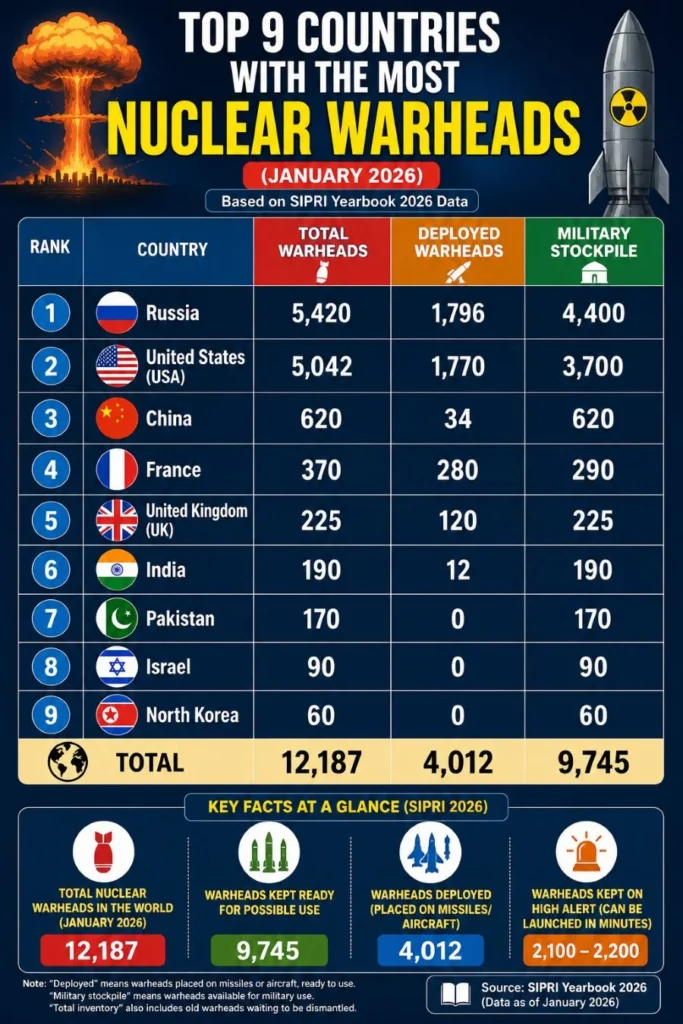
Top 9 Countries with the Most Nuclear Warheads (January 2026)
Here is the complete ranking based on SIPRI 2026 data:
| Rank | Country | Total Warheads | Deployed Warheads | Military Stockpile |
|---|---|---|---|---|
| 1 | Russia | 5,420 | 1,796 | 4,400 |
| 2 | United States (USA) | 5,042 | 1,770 | 3,700 |
| 3 | China | 620 | 34 | 620 |
| 4 | France | 370 | 280 | 290 |
| 5 | United Kingdom (UK) | 225 | 120 | 225 |
| 6 | India | 190 | 12 | 190 |
| 7 | Pakistan | 170 | 0 | 170 |
| 8 | Israel | 90 | 0 | 90 |
| 9 | North Korea | 60 | 0 | 60 |
| Total | 12,187 | 4,012 | 9,745 |
Source: SIPRI Yearbook 2026 (data as of January 2026)
What is SIPRI?
The Stockholm International Peace Research Institute (SIPRI) is an independent international institute that is dedicated to research into conflicts, armaments, arms control, and arms expenditure.
It was established in 1966, which usually provides the data and analysis on arms-related research works. It gives the statistic data on the transfer of major arms using a common unit, Trend-Indicator-Value (TIV).
SIPRI 2026: Key Facts at a Glance
According to the SIPRI Yearbook 2026:
- Total nuclear warheads in the world (January 2026): 12,187
- Warheads kept ready for possible use: 9,745
- Warheads deployed (placed on missiles/aircraft): 4,012
- Warheads kept on high alert (can be launched in minutes): 2,100 to 2,200
- All 9 nuclear-armed countries are modernising (upgrading) their nuclear weapons.
Country-Wise Analysis of Those That Have the Most Nuclear Warheads in 2026
1. Russia (5,420 Warheads)
Russia has the largest nuclear arsenal in the world. As of January 2026, Russia has:
- Total warheads: 5,420
- Deployed warheads: 1,796
- Military stockpile: 4,400
Russia and the USA together hold about 83% of all useable nuclear warheads in the world. Russia is also building a forward base for its Oreshnik missile in Belarus. SIPRI 2026 notes that Russia’s modernisation programme is continuing and its arsenal may grow further in the coming years.
2. United States or USA (5,042 Warheads)
The USA comes second in the world for nuclear warheads. As of January 2026:
- Total warheads: 5,042
- Deployed warheads: 1,770
- Military stockpile: 3,700
The USA has a big nuclear modernisation programme going on, though it faced some funding challenges in 2025. Nearly all warheads on high alert belong to either Russia or the USA.
3. China (620 Warheads)
China is now third in the world for total nuclear warheads. As of January 2026:
- Total warheads: 620
- Deployed warheads: 34 (up from 24 in 2025)
- Military stockpile: 620
According to SIPRI 2026, China is expanding its nuclear arsenal faster than any other country. China has loaded hundreds of missiles into large missile silo fields in northern China. SIPRI says that by the end of this decade, China could have as many ICBMs (long-range missiles) as Russia or the USA.
Where does India stand in the number of nuclear warheads?
India is ranked sixth in the world with 190 nuclear warheads and is the largest nuclear power in South Asia by warhead count. As of January 2026:
- Total warheads: 190
- Deployed warheads: 12
- Military stockpile: 190
According to SIPRI 2026, India has a nuclear triad, which means it can launch nuclear weapons from land (missiles), sea (submarines), and air (aircraft). India’s nuclear arsenal grew slightly from the previous year. India’s nuclear deterrent focuses primarily on Pakistan, but India is also developing longer-range weapons capable of reaching targets in China.
Note: India follows a No First Use (NFU) policy, which means India will not be the first country to use nuclear weapons in a conflict. India is not a signatory to the Nuclear Non-Proliferation Treaty (NPT).
Important Key Points for UPSC Exams
This topic is important for UPSC Prelims (GS Paper II) and Mains (GS Paper II and III).
So, for your exams, here are important key points for UPSC exams to remember:
Nuclear Clubs and Treaties:
- The Nuclear Non-Proliferation Treaty (NPT) recognises only 5 “official” nuclear weapon states: USA, Russia, UK, France, and China (the P5). India, Pakistan, Israel, and North Korea are not NPT signatories.
- The Comprehensive Nuclear-Test-Ban Treaty (CTBT) bans all nuclear tests. India, Pakistan, and North Korea have not signed it.
- The New START Treaty was a nuclear arms reduction treaty between the USA and Russia.
India’s Nuclear Policy:
- India’s nuclear doctrine follows No First Use (NFU) and minimum credible deterrence.
- India has a nuclear triad since the INS Arihant submarine became operational.
- India is not a member of the NPT but has a Civil Nuclear Agreement with the USA (123 Agreement, 2008) and is a member of the Nuclear Suppliers Group (NSG) waiver.
SIPRI (Stockholm International Peace Research Institute):
- SIPRI is an independent think tank based in Stockholm, Sweden.
- It publishes the SIPRI Yearbook every year with data on arms, military spending, and nuclear weapons.
- SIPRI Yearbook 2026 was released on 8 June 2026.
Why Are Countries Increasing Nuclear Weapons?
According to SIPRI Director Karim Haggag, countries are “increasingly relying on nuclear weapons as instruments of national power.” This is a worrying trend because:
- The risks of accidental nuclear war (miscalculation) are growing.
- The breakdown of nuclear arms control agreements has created uncertainty.
- Geopolitical tensions across the world are rising.
- All 9 nuclear-armed countries are modernising their weapons.
SIPRI warns that the long trend of reducing nuclear weapons, which started after the Cold War, is likely to be reversed in the coming years.