Last Updated on May 22, 2026 by Parikshit
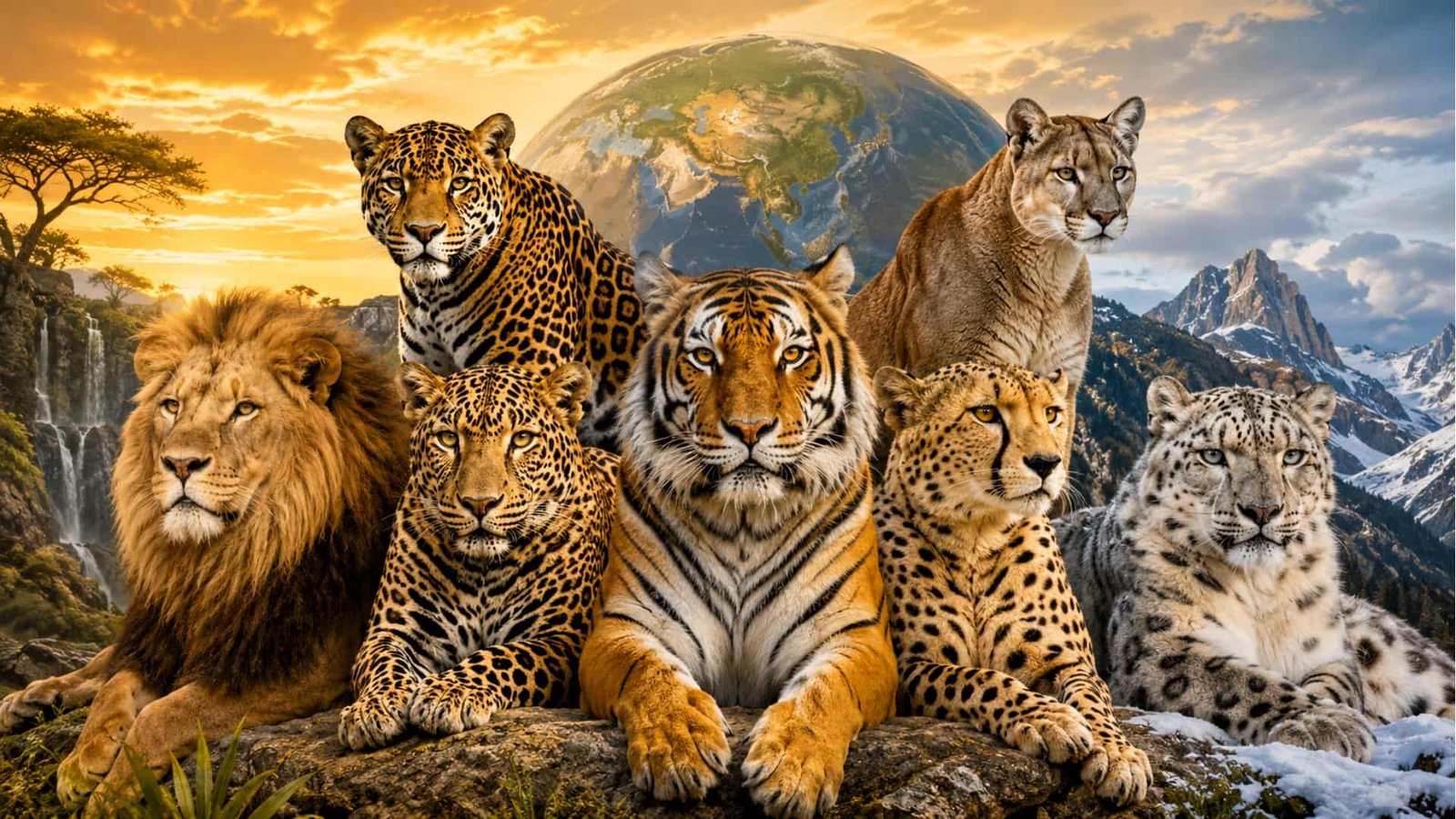
India is home to many big cat species, including tigers, lions, leopards, and many more. To save these big cat species, like tigers, India launched the Tiger Project in April 1973, and on the completion of 50 years of the Tiger Project, Honourable Indian Prime Minister Narendra Modi launched the International Big Cat Alliance (IBCA) for global conservation of big cat species at Mysuru, Karnataka, on April 09, 2023.
Officially, it was announced that India is going to organise its first IBCA Summit on June 1 and 2, 2026, at Bharat Mandapam & Hotel Taj Palace, New Delhi. As per PIB, “It was being organised in conjunction with the Fourth India–Africa Forum Summit (IAFS IV), but there has been a rescheduling of the First International Big Cat Alliance (IBCA) Summit.” The new date for the Summit will be announced in due course, following consultations with participating countries and stakeholders.”
But with all these, do you know what IBCA is and how many big cat species are found in the International Big Cat Alliance? What is the objective of IBCA, and why is India’s role so important in IBCA?
So, let’s explore this article in detail and learn more about the IBCA with all its interesting facts.
What is the International Big Cat Alliance (IBCA)?
The International Big Cat Alliance (IBCA) is a multi-country, multi-agency coalition of 96 big cat range countries and non-range countries that aims to conserve the 7 big cat species and their habitats in all over the regions where they are found.
Also Read: India to Host 1st IBCA Summit in June 2026
How Many Big Cat Species Are Found in the IBCA?
Source: IBCA
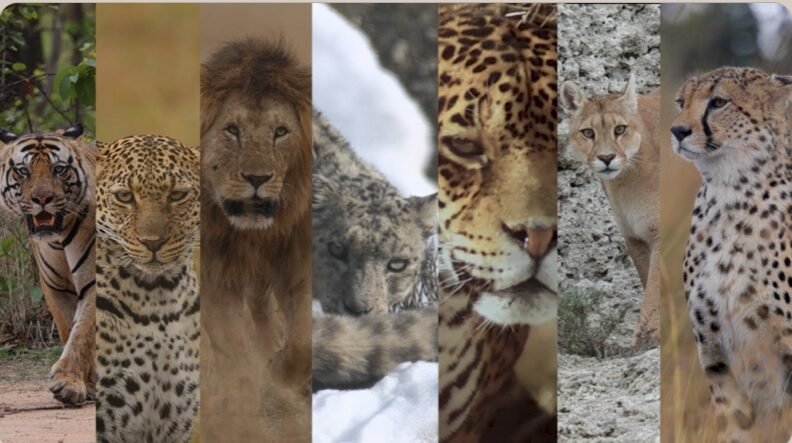
There are seven big cat species in the International Big Cat Alliance (IBCA), which usually focuses on the conservation of their species and habitat in the world. These 7 big cat species are:
- Tiger
- Lion
- Leopard
- Snow Leopard
- Cheetah
- Jaguar
- Puma
Also Read: What is the National Animal of India?
How Many Big Cat Species Are Found In India?
Out of 7, 5 Big Cat Species are found in India, which is recognised by IBCA. These five big cats in India are:
- Tiger
- Asiatic Lion
- Leopard
- Snow Leopard
- Cheetah (It is reintroduced in 2022 after being extinct in India for over 70 years)
The other two big cat species, Jaguar and Puma, are not found in India. They are mainly found in South America.
What Is the Total Number of 5 Big Cat Species in India?
According to the National Tiger Conservation Authority (NTCA), here is given the total number of 5 Big Cat Species in India in a table:
| Big Cat | Where it’s Found in India | Total Number |
| Tiger | MP, Uttarakhand, Karnataka, etc. | 3,682 (2022 Census, NTCA) |
| Asiatic Lion | Gir National Park, Gujarat | 891 (2025, MoEFCC) |
| Leopard | All over India | 13,874 (2022, NTCA/WII) |
| Snow Leopard | Ladakh, Himachal Pradesh, Uttarakhand | 718 (first scientific count, WII) |
| Cheetah | Kuno National Park, MP | 50+ individuals (including cubs, 2025) |
Source: National Tiger Conservation Authority (NTCA)
What is the objective of IBCA?
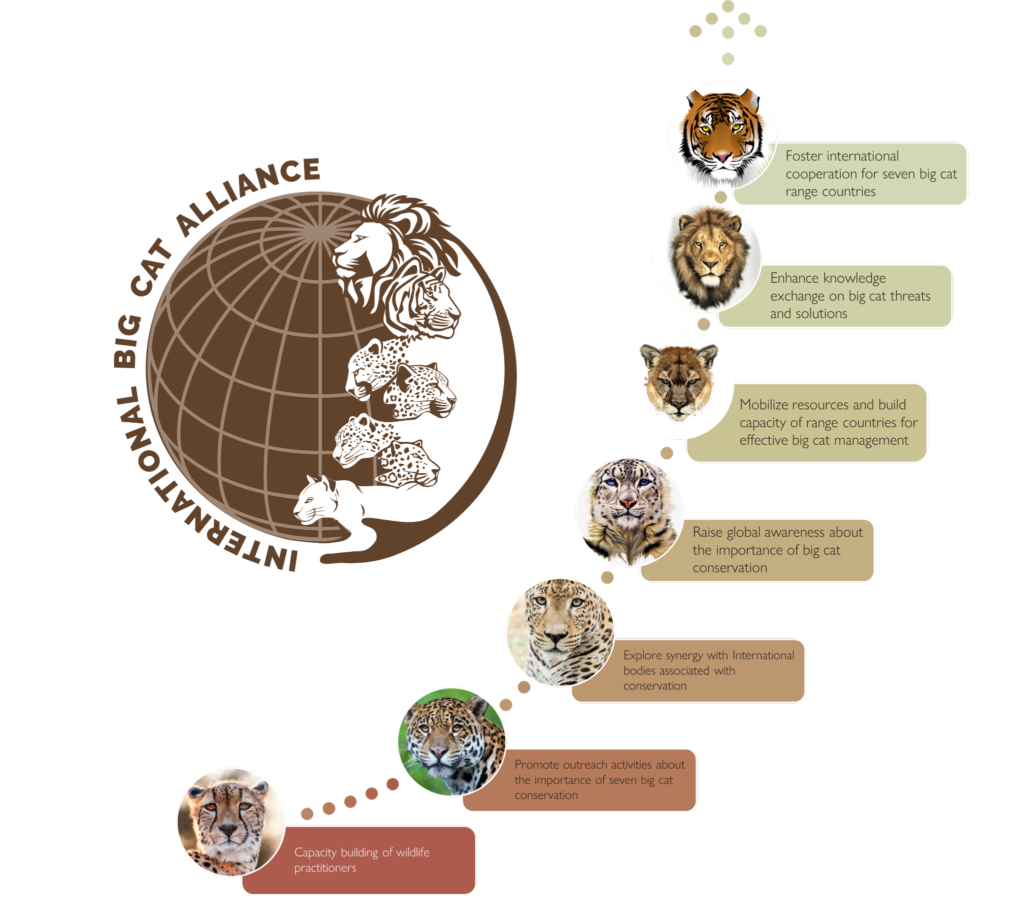
The main objective of the IBCA is to bring all different countries together for global collaboration to conserve the big cat species. In 2026, 27 countries have joined the IBCA. The IBCA wants multiple countries, conservation partners, and scientific organisations to come together and make the alliance and stand against the threat to big cat species.
The alliance works dependently on all 7 big cat species, which are:
- Tiger: Foster international cooperation for seven big cat range countries
- Lion: Enhance knowledge exchange on big cat threats and solutions
- Puma: Mobilize resources and build capacity of range countries for effective big cat management
- Snow Leopard: Raise global awareness about the importance of big cat conservation
- Leopard: Explore synergy with International bodies associated with conservation
- Jaguar: Promote outreach activities about the importance of seven big cat conservation
- Cheetah: Capacity building of wildlife practitioners
Why Is India’s Role in IBCA So Important?
India is not just a member of IBCA; it has initiated and is leading this alliance. The headquarters of the IBCA is in New Delhi. In June 2025, the inaugural General Assembly of IBCA was organised in New Delhi, India, where Bhupender Yadav, the Indian Minister for Environment, was elected as the first President of IBCA.
India has demonstrated to the world the ability to save big cats. The number of tigers in India increased 30% over the past decade. The Asiatic Lion population increased by 32% from 2020 and is now 891. In 2022, India became one of the only few countries in the world to successfully reintroduce a big cat when the cheetah was brought back to the country after over 70 years.
Interesting Facts About IBCA and Big Cats
- IBCA was launched on the 50th anniversary of Project Tiger on April 9, 2023.
- In 2026, India has a total of 58 Tiger Reserves, which is the highest number of the Tiger Reserves in the world.
- The snow leopard is the state animal of both Ladakh and Himachal Pradesh.
- India is collaborating with Namibia, South Africa, and Botswana for cheetah reintroduction.
- The Framework Agreement of IBCA officially came into force on January 23, 2025.
- India is the only country in the world with all five of IBCA’s big cats naturally or reintroduced on its land.
So, India is home to 5 Big Cat Species among the 7, and India is also the founding member of IBCA, which was established April 9, 2023, on the successful completion of 50 years of Project Tiger. IBCA covers 7 big cat species: Tiger, Lion, Leopard, Snow Leopard, Cheetah, Jaguar, and Puma. India truly represents the importance of wildlife and is always dedicated to the conservation of wildlife, whether in launching Project Tiger to conserve the Snow Leopard, or in bringing cheetahs from Namibia, South Africa, and Botswana. All these works show how India is working hard in protecting all these big cat species.
Sharing is always known to be the best part. So do share with your friend, and to read more articles like this, visit GKinfoBuzz regularly.