Last Updated on June 30, 2026 by Parikshit
For many decades, Indian trains have mainly relied on diesel or electricity. But, recently, on 22 May 2026, the Railway Board approved India’s first hydrogen-powered train, and by approving this initiative, it shows how Indian Railways is beginning to explore its journey toward green & sustainable transportation.
With this initiative, India is now among the most advanced countries that are using hydrogen trains. So, let’s explore everything about India’s first hydrogen train, how it works, where it will run, and why it is important in Indian Railways.
What is the Hydrogen Train?
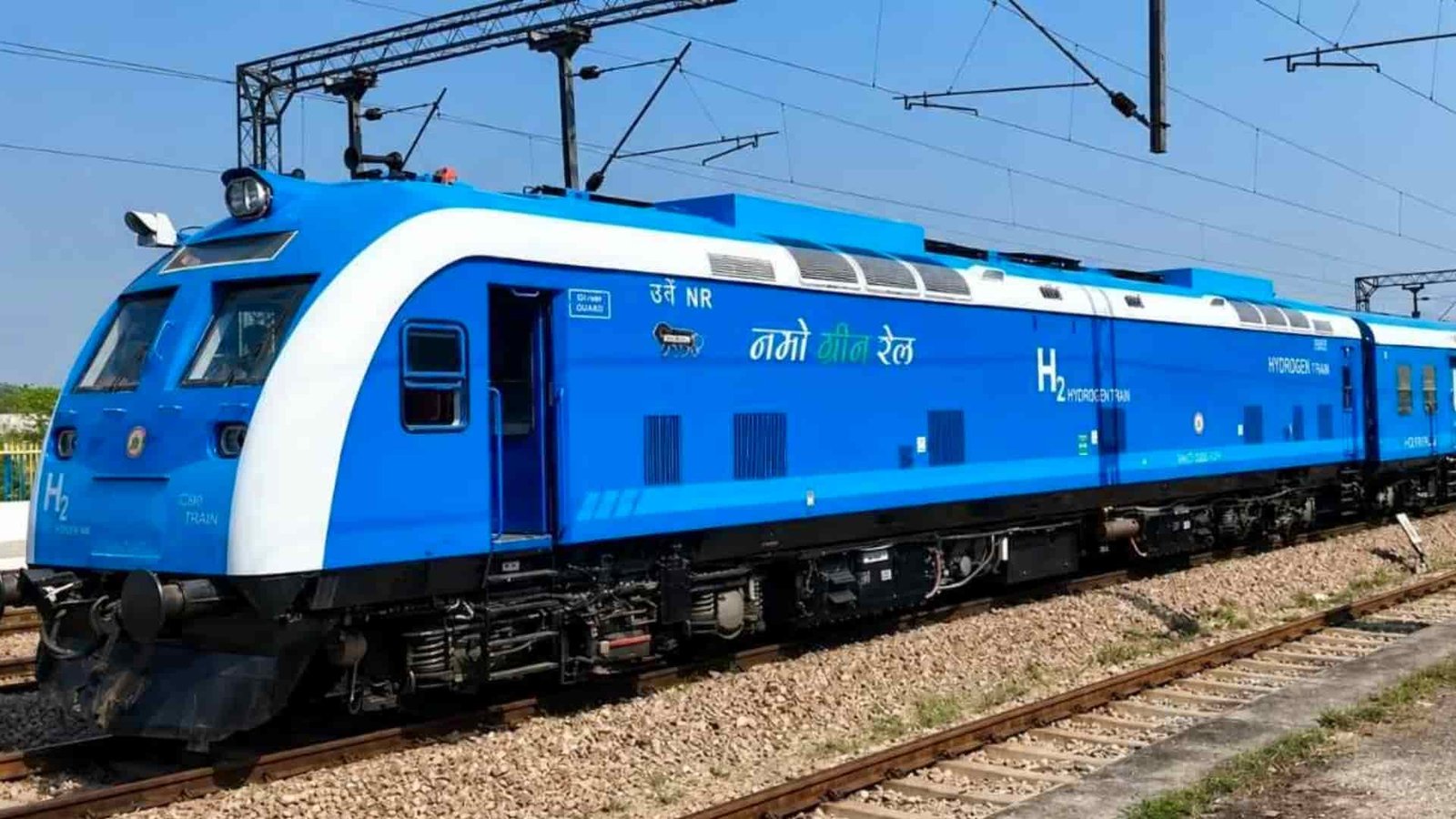
The hydrogen train uses a hydrogen fuel cell to generate electricity instead of using diesel or an electric line. The trainset consists of 10 coaches and is built using hydrogen fuel cell technology and is known as Hydrogen Fuel Cell-based DPRS 1200 KW DEMU (Diesel Electric Multiple Unit).
According to the PIB, “Indian Railways has approved the introduction of a 10-car Hydrogen Fuel Cell-based trainset on the dedicated Jind-Sonipat section of Northern Railway. The trainset is all set to start soon and will be capable of running at a maximum speed of 75 kmph on a 1200 KW hydrogen fuel cell propulsion system.”
This train was built with the support of the Medha Servo Drives and Integral Coach Factory (ICF), Chennai, and Ballard Power Systems, which helps in the supply of the fuel cell modules
Medha Servo Drives and Integral Coach Factory (ICF), Chennai, were the supporters in the construction of the train. Fuel cell modules were supplied by Ballard Power Systems, a world leader in hydrogen fuel cell technology.
Key facts at a glance:
- Route: Jind to Sonipat, Haryana
- Formation: 10 coaches (2 Driving Power Cars + 8 passenger coaches)
- Maximum Speed: 75 kmph (approved for operations); reports suggest it can go up to 110 kmph
- Engine Power: 1,200 HP (making it one of the most powerful hydrogen trains in the world)
- Passenger Capacity: Up to 2,638 passengers
- Hydrogen Plant: Located at Jind, with a storage capacity of 3,000 kg
Also Read: Who Discovered Radioactivity?
What Are The Working Principles Of Hydrogen Fuel Cell Technology?
The working principles of hydrogen fuel cell technology are given below:
Step 1: Hydrogen will be stored in the train and will be carried on the train in special high-pressure tanks. The Jind hydrogen plant produces this hydrogen through a process known as ‘electrolysis,’ which involves splitting water (H₂O) into hydrogen and oxygen with the help of electricity.
Step 2: The hydrogen is fed into the fuel cell, and it gets fed into the negative side (anode), and oxygen from the air is fed into the positive side (cathode).
Step 3: The electricity is now produced by a chemical reaction, and because of the chemical reaction, the hydrogen and oxygen gases react with each other inside the fuel cell. The result of this reaction is the production of three things: electricity, heat, and water. The electricity is used to power the electric motors that move the train.
Step 4: Water is purged after the reaction, and only water vapor is present in the exhaust. There is not any visible smoke or carbon dioxide without any pollution. This makes it a real clean technology.
A hydrogen fuel cell is like a battery, except that the cell produces power continuously so long as it is continuously supplied with hydrogen and oxygen.
What is Electrolysis?
Electrolysis is the process of using electricity to split the water into hydrogen and oxygen, and the reaction that takes place in a unit is called an electrolyser.
This process is used to get the carbon-free hydrogen production from the renewable source.
Quick Facts
- The first hydrogen train in India will be introduced on the Jind-Sonipat route in Haryana.
- In May 2026, the Railway Board gave its nod to the first-ever hydrogen train in India.
- Ballard Power Systems’ fuel cell modules (100 kW) are used in the train.
- The Jind hydrogen plant uses green electrolysis to produce hydrogen.
- The only exhaust from the train is water vapour.
- Indian Railways is working towards achieving the target of becoming ‘Net Zero’ by 2030.
- India becomes a part of the hydrogen train club, which includes Germany, the US, Japan, and China.
Why Is The Jind Hydrogen Plant Important For This Initiative?
To operate this train, hydrogen is the most important. Hence, a special hydrogen plant has been established at Jind. This plant is based on electrolysing water to make hydrogen. Here, a 1 megawatt electrolyser is installed to generate green hydrogen. The plant can store 3000 kg of hydrogen. A stable power supply of 11 kV has been made to ensure continuity of the plant.
How Is The Hydrogen Train Different From A Normal Train?
Here are some features that make the Hydrogen Train different from a normal train, which are given below in a table format:
| Feature | Diesel Train | Hydrogen Train |
| Fuel | Diesel | Hydrogen |
| Exhaust | Carbon dioxide, smoke | Only water vapour |
| Engine type | Combustion engine | Fuel cell + electric motor |
| Noise | High | Low |
| Refuel time | Less than 30 minutes | Less than 20 minutes |
National Green Hydrogen Mission of India
Indian Railways is one of the world’s largest rail networks. Today, most trains are diesel or electric. However, the hydrogen train does not need any electricity or any fuel, such as diesel.
They are able to run on tracks that are not electrified. This is a significant saving in the massive expense of constructing electrical facilities on lesser-traveled roads. It also enjoys less pollution, less carbon, and green, sustainable transportation in India.
Why Is This Initiative Important For India?
India has a very large railway system that links different states of India. While most of the tracks are not electrified, hydrogen trains can run on routes without any overhead wires needed. This saves the huge cost of building electrical infrastructure and railway track.
It also represents less pollution, lower carbon emissions, and a cleaner future for millions of passengers who ride the train daily.
This is a historic step for Indian Railways to move towards the clean energy and green future of India with the introduction of the first hydrogen train in the country.