Last Updated on July 17, 2026 by Gaurav
Key Takeaways
- R. K. Shanmukham Chetty was the first Finance Minister of independent India.
- Since independence, India has had a total of 36 Finance Ministers including interim appointments and repeated tenures.
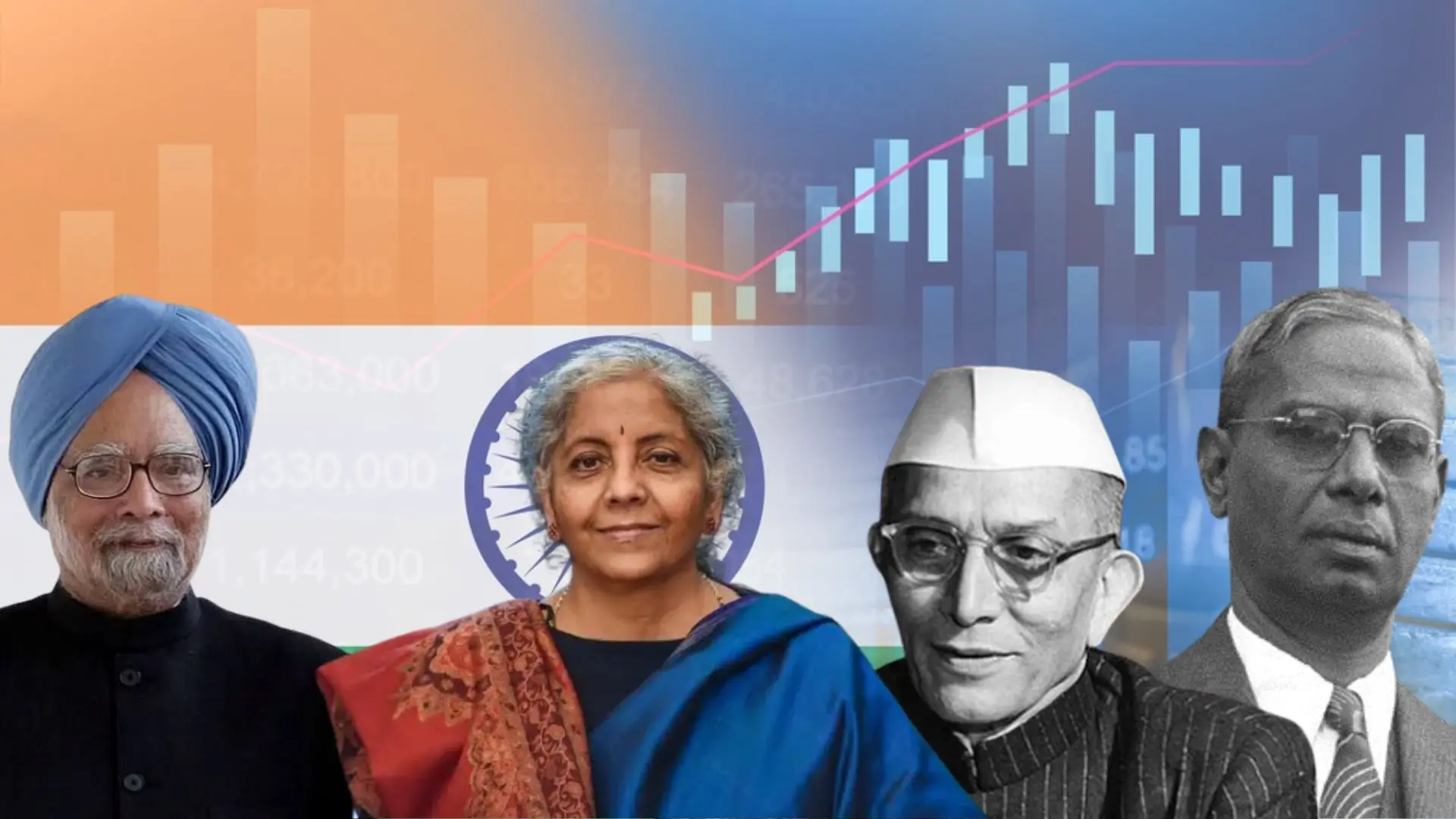
- Nirmala Sitharaman is the current Finance Minister of India and she is serving since 2019. Moreover, she is the first full-time female Finance Minister of India.
- Morarji Desai has presented the most number of Union Budgets in the country’s history.
- Arun Jaitley oversaw the implementation of the Goods and Services Tax (GST).
India is a strong nation when it comes to finances. The country has overcome various economic problems and all the credit goes to the Finance Ministers of the nation. Since Independence of India in 1947, the country has seen many Finance Ministers and each one of them played a significant part in the country’s economy.
The Finance Minister’s position is one of the most important in the Government of India. Whether it was building the nation after partition in 1947, opening the economy in 1991, or managing the nation’s budgets in difficult times, Finance Ministers of India have been at the front row. That is why here is the complete list of Finance Ministers of India.
Complete List of Finance Ministers of India (1947 – 2026)
Here is the complete list of Finance Ministers of India as per the Department of Economic Affairs:
| No. | Name | Tenure |
| 1 | Liaquat Ali Khan | Oct 1946 to Aug 1947 |
| 2 | R. K. Shanmukham Chetty | Aug 1947 to Aug 1948 |
| 3 | John Mathai | Sep 1948 to Jun 1950 |
| 4 | C. D. Deshmukh | Jun 1950 to Aug 1956 |
| 5 | T. T. Krishnamachari | Aug 1956 to Feb 1958 |
| 6 | Jawaharlal Nehru | Feb 1958 to Mar 1958 |
| 7 | Morarji Desai | Mar 1958 to Aug 1963 |
| 8 | T. T. Krishnamachari | Aug 1963 to Dec 1965 |
| 9 | Sachindra Chaudhuri | Jan 1966 to Mar 1967 |
| 10 | Morarji Desai | Mar 1967 to Jul 1969 |
| 11 | Indira Gandhi | Jul 1969 to Jun 1970 |
| 12 | Yashwantrao B. Chavan | Jun 1970 to Oct 1974 |
| 13 | Chidambaram Subramaniam | Oct 1974 to Mar 1977 |
| 14 | Haribhai M. Patel | Mar 1977 to Jan 1979 |
| 15 | Charan Singh | Jan 1979 to Jul 1979 |
| 16 | Hemvati Nandan Bahuguna | Jul 1979 to Oct 1979 |
| 17 | R. Venkataraman | Jan 1980 to Jan 1982 |
| 18 | Pranab Mukherjee | Jan 1982 to Jan 1987 |
| 19 | V. P. Singh | Dec 1984 to Jan 1987 |
| 20 | Rajiv Gandhi | Jan 1987 to Jul 1987 |
| 21 | N. D. Tiwari | Jul 1987 to Jun 1988 |
| 22 | Shankarrao B. Chavan | Jun 1988 to Dec 1989 |
| 23 | Madhu Dandavate | Dec 1989 to Nov 1990 |
| 24 | Yashwant Sinha | Nov 1990 to Jun 1991 |
| 25 | Manmohan Singh | Jun 1991 to May 1996 |
| 26 | Jaswant Singh | May 1996 to Jun 1996 |
| 27 | P. Chidambaram | Jun 1996 to Apr 1997 |
| 28 | I. K. Gujral | Apr 1997 to May 1997 |
| 29 | P. Chidambaram | May 1997 to Mar 1998 |
| 30 | Yashwant Sinha | Mar 1998 to Jul 2002 |
| 31 | Jaswant Singh | Jul 2002 to May 2004 |
| 32 | P. Chidambaram | May 2004 to Nov 2008 |
| 33 | Pranab Mukherjee | Nov 2008 to Jun 2012 |
| 34 | P. Chidambaram | Jun 2012 to May 2014 |
| 35 | Arun Jaitley | May 2014 to May 2019 |
| 36 | Nirmala Sitharaman | May 2019 to Present |
Who Appoints the Finance Minister of India?
The Finance Minister of India is appointed by the President of India and this appointment is made on the advice of the Prime Minister of India. One of the major responsibilities of the Finance Minister of India is to prepare and present the Budget of India that is presented every financial year.
The Finance Minister of India also manages many key departments such as the Department of Economic Affairs, Department of Revenue, Department of Expenditure, Department of Financial Services, and the Department of Investment and Public Asset Management
Who is the Current Finance Minister of India?
The current Finance Minister of India is Nirmala Sitharaman and she took the position On May 31, 2019 . She is the first female to become a full-time Finance Minister in the country. As of 2026, she has presented a total of 9 budgets during her tenure. She will continue to serve as the Finance Minister till the next General Elections in 2029.
Finance Ministers Who Became Prime Minister of India
There were several Finance Ministers who have also served as the Prime Minister of India. Here is a brief overview:
| Finance Minister | Tenure as Finance Minister | Tenure as Prime Minister |
| Morarji Desai | March 1958 – August 1963 and March 1967 – July 1969 | 24 March 1977 – 28 July 1979 |
| Indira Gandhi | July 1969 – June 1970 | 24 January 1966 – 24 March 1977 and 14 January 1980 – 31 October 1984 |
| Charan Singh | January 1979 – July 1979 | 28 July 1979 – 14 January 1980 |
| Rajiv Gandhi | January 1987 – July 1987 (Additional Charge) | 31 October 1984 – 2 December 1989 |
| V. P. Singh | December 1984 – January 1987 | 2 December 1989 – 10 November 1990 |
| I. K. Gujral | April 1997 – May 1997 (Additional Charge) | 21 April 1997 – 19 March 1998 |
| Manmohan Singh | June 1991 – May 1996 | 22 May 2004 – 26 May 2014 |
Important Facts About Finance Ministers of India
First Finance Minister: R. K. Shanmukham Chetty (1947) and he served till August 1948.
First Female Finance Minister: Nirmala Sitharaman (2019). She is also the first woman to serve as a full-time Finance Minister.
Most Budgets Presented: Morarji Desai presented a total of 10 budgets which included two interim budgets. This made him the Finance Minister with the most budget presentations in the history of India.
Most Tenures as Finance Minister: P. Chidambaram has served as Finance Minister 4 times and that too under different governments.
Longest Continuous Tenure: Nirmala Sitharaman has been serving continuously as the Finance Minister of India since May 2019. This makes her one of the longest-serving Finance Ministers in recent history.
Notable Finance Ministers and Their Contributions
R. K. Shanmukham Chetty (1947 to 1948): He was the first person to present the first budget of independent India. His primary task was to stabilize the economy after the partition of India and Pakistan when the resources of the country were divided and different resources of the country were affected.
C. D. Deshmukh (1950 to 1956): He was the first Indian Governor of the Reserve Bank of India (RBI) after independence before he took charge as the Finance Minister of India. He had a very important contribution in establishing the initial framework of economic planning in India and he was a supporter of the first Five-Year Plan.
Morarji Desai (1958 to 1963 and 1967 to 1969): Morarji Desai has presented the most number of budgets in the history of India.
Manmohan Singh (1991 to 1996): His role is one the most significant ones in the economic history of India. In 1991, India had a very serious balance of payments problem. The foreign exchange reserves had reduced to the point where India was not even able to cover two weeks of imports.
That is when Manmohan Singh as the Finance Minister under Prime Minister P. V. Narasimha Rao, implemented many important economic reforms. He deregulated industries, slashed import duties and removed the old Licence Raj system.
P. Chidambaram (Multiple terms from 1996 to 2014): P. Chidambaram had four terms of Finance Ministry during various governments. His “Dream Budget” of 1997, drastically reduced income tax rates and helped to streamline the tax structure.
Arun Jaitley (2014 to 2019): The Goods and Services Tax (GST) was introduced by Finance Minister Arun Jaitley in 2017 and is India’s largest tax reform since Independence.
Nirmala Sitharaman (2019 to Present): Nirmala Sitharaman is the current Finance Minister. She has presented the highest number of consecutive Union Budgets by any finance minister. She managed India’s economy during the COVID-19 situation.
For more such well-researched GK articles helpful for exam aspirants and general readers seeking authentic and up-to-date coverage of current affairs, history, polity, science, technology, economy, sports, and beyond, keep exploring various categories of GKinfoBuzz, your trusted resource for knowledge and information.