Last Updated on May 23, 2026 by Bharat
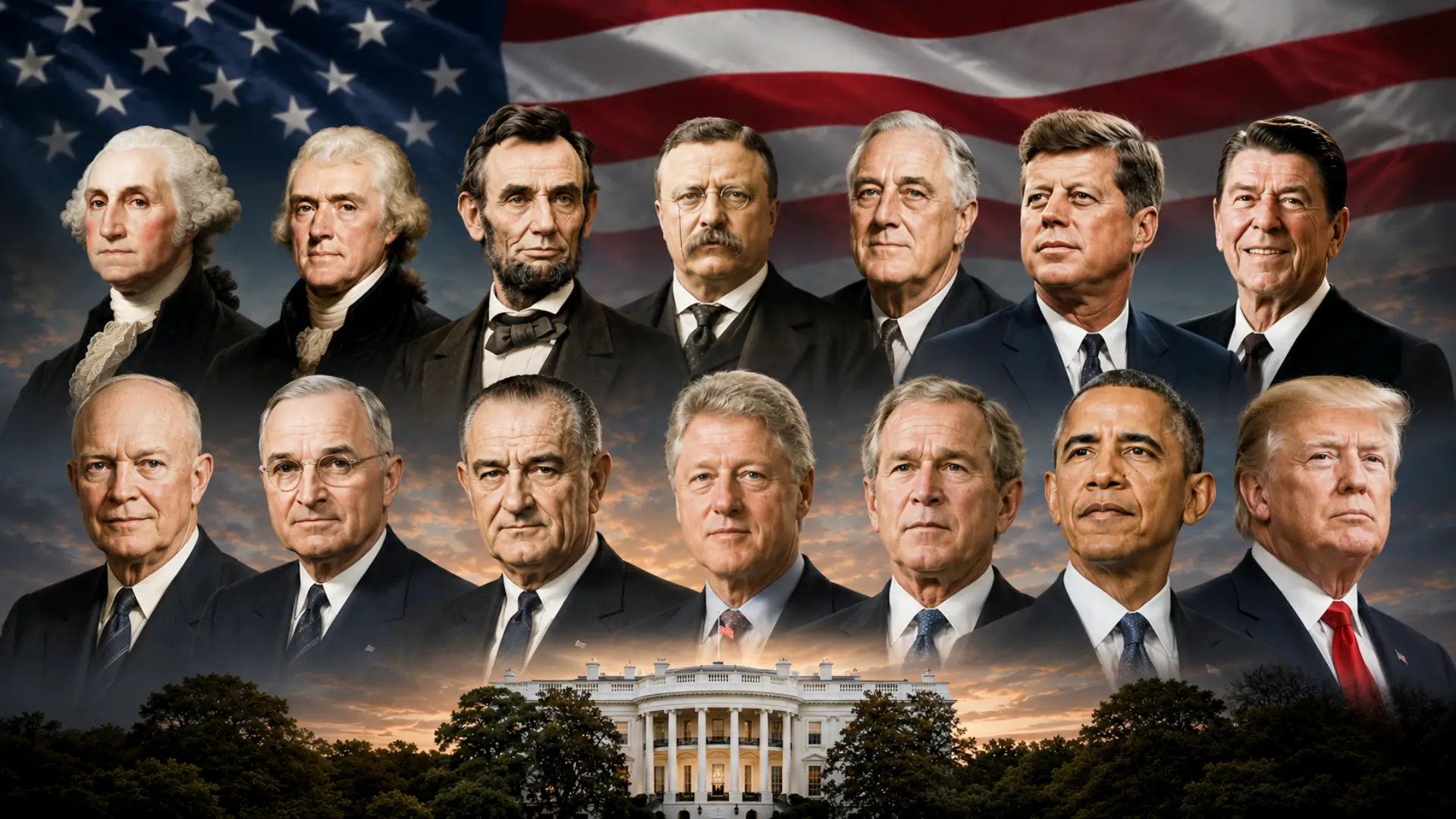
The list of presidents of the United States covers more than 230 years of democratic leadership. Since 1789, a total of 47 individuals have held the office. The president serves as head of state and head of government. This article provides a complete record of every US president, their term dates, political party, and key facts.
The United States has had 47 presidents since George Washington was inaugurated on April 30, 1789. The US Presidents serve four-year terms. The 22nd Amendment, ratified in 1951, limits any president to only two elected terms.
Who is the Current President of the United States?
Donald Trump is the current and the 47th president of the United States, having taken office on January 20, 2025. Trump is the second person after Grover Cleveland to serve two non-consecutive terms. Cleveland was the 22nd and 24th President of the United States
Presidents of United States: Key Facts at a Glance
| Fact | Detail |
| Total presidents(as of 2026) | 47 |
| Distinct individuals who served as presidents | 45 |
| First president | George Washington (1789–1797) |
| Current president | Donald Trump (47th, since January 20, 2025) |
| Longest-serving president | Franklin D. Roosevelt (~12 years, 1933–1945) |
| Presidents assassinated in office | 4: Lincoln, Garfield, McKinley, Kennedy |
| Only president to resign | Richard Nixon (August 9, 1974) |
| Non-consecutive term presidents | Grover Cleveland (22nd and 24th) and Donald Trump (45th and 47th) |
| Two-term limit established by | 22nd Amendment, ratified February 27, 1951 |
How the US Presidential System Works
The US president is elected every four years through the Electoral College. Each of the 50 states has a set number of electoral votes. A candidate needs at least 270 of the 538 total votes to win. The popular vote does not directly determine the outcome.
Presidents are sworn in (inaugurated) on January 20 following the November election. This date was set by the 20th Amendment, ratified in 1933. Before that, inauguration day was March 4. The term “lame duck” refers to the outgoing president during the gap between election day and inauguration day.
List of Presidents of the United States: Complete Tenure and Party
The table below lists all 47 presidents in order. It includes term start and end dates, political party, and key notes.
| Sl.No | President | Term Start | Term End | Party | Notes |
| 1 | George Washington | Apr 30, 1789 | Mar 4, 1797 | Independent | No formal party; set the two-term precedent |
| 2 | John Adams | Mar 4, 1797 | Mar 4, 1801 | Federalist | |
| 3 | Thomas Jefferson | Mar 4, 1801 | Mar 4, 1809 | Democratic-Republican | Principal author of the Declaration of Independence |
| 4 | James Madison | Mar 4, 1809 | Mar 4, 1817 | Democratic-Republican | Led the US during the War of 1812 |
| 5 | James Monroe | Mar 4, 1817 | Mar 4, 1825 | Democratic-Republican | Announced the Monroe Doctrine (1823) |
| 6 | John Quincy Adams | Mar 4, 1825 | Mar 4, 1829 | Democratic-Republican / National Republican | Son of President John Adams |
| 7 | Andrew Jackson | Mar 4, 1829 | Mar 4, 1837 | Democrat | Founded the modern Democratic Party |
| 8 | Martin Van Buren | Mar 4, 1837 | Mar 4, 1841 | Democrat | First president born as a US citizen |
| 9 | William Henry Harrison | Mar 4, 1841 | Apr 4, 1841 | Whig | Died in office after 31 days; shortest presidency |
| 10 | John Tyler | Apr 4, 1841 | Mar 4, 1845 | Whig (later unaffiliated) | Succeeded Harrison; first VP to assume presidency |
| 11 | James K. Polk | Mar 4, 1845 | Mar 4, 1849 | Democrat | Oversaw major westward territorial expansion |
| 12 | Zachary Taylor | Mar 4, 1849 | Jul 9, 1850 | Whig | Died in office; served 16 months |
| 13 | Millard Fillmore | Jul 9, 1850 | Mar 4, 1853 | Whig | Succeeded Taylor |
| 14 | Franklin Pierce | Mar 4, 1853 | Mar 4, 1857 | Democrat | |
| 15 | James Buchanan | Mar 4, 1857 | Mar 4, 1861 | Democrat | Only president never to marry |
| 16 | Abraham Lincoln | Mar 4, 1861 | Apr 15, 1865 | Republican | Assassinated; led the Union in the Civil War |
| 17 | Andrew Johnson | Apr 15, 1865 | Mar 4, 1869 | National Union / Democrat | Succeeded Lincoln; first president to be impeached |
| 18 | Ulysses S. Grant | Mar 4, 1869 | Mar 4, 1877 | Republican | Union general in the Civil War |
| 19 | Rutherford B. Hayes | Mar 4, 1877 | Mar 4, 1881 | Republican | |
| 20 | James A. Garfield | Mar 4, 1881 | Sep 19, 1881 | Republican | Assassinated; served about 6 months |
| 21 | Chester A. Arthur | Sep 19, 1881 | Mar 4, 1885 | Republican | Succeeded Garfield |
| 22 | Grover Cleveland | Mar 4, 1885 | Mar 4, 1889 | Democrat | First term |
| 23 | Benjamin Harrison | Mar 4, 1889 | Mar 4, 1893 | Republican | Grandson of President William Henry Harrison |
| 24 | Grover Cleveland | Mar 4, 1893 | Mar 4, 1897 | Democrat | Second term; only non-consecutive presidency until Trump |
| 25 | William McKinley | Mar 4, 1897 | Sep 14, 1901 | Republican | Assassinated; led the US in the Spanish-American War |
| 26 | Theodore Roosevelt | Sep 14, 1901 | Mar 4, 1909 | Republican | Succeeded McKinley; youngest person to become president (age 42) |
| 27 | William Howard Taft | Mar 4, 1909 | Mar 4, 1913 | Republican | Later served as Chief Justice of the Supreme Court |
| 28 | Woodrow Wilson | Mar 4, 1913 | Mar 4, 1921 | Democrat | Led the US in World War I; proposed the League of Nations |
| 29 | Warren G. Harding | Mar 4, 1921 | Aug 2, 1923 | Republican | Died in office |
| 30 | Calvin Coolidge | Aug 2, 1923 | Mar 4, 1929 | Republican | Succeeded Harding |
| 31 | Herbert Hoover | Mar 4, 1929 | Mar 4, 1933 | Republican | Presidency marked by the Great Depression |
| 32 | Franklin D. Roosevelt | Mar 4, 1933 | Apr 12, 1945 | Democrat | Died in office; longest-serving president. |
| 33 | Harry S. Truman | Apr 12, 1945 | Jan 20, 1953 | Democrat | Succeeded FDR; ordered the atomic bombs on Japan (1945) |
| 34 | Dwight D. Eisenhower | Jan 20, 1953 | Jan 20, 1961 | Republican | Supreme Allied Commander in World War II |
| 35 | John F. Kennedy | Jan 20, 1961 | Nov 22, 1963 | Democrat | Assassinated in Dallas; youngest elected president (age 43) |
| 36 | Lyndon B. Johnson | Nov 22, 1963 | Jan 20, 1969 | Democrat | Succeeded Kennedy; signed the Civil Rights Act of 1964 |
| 37 | Richard Nixon | Jan 20, 1969 | Aug 9, 1974 | Republican | Only president to resign; Watergate scandal |
| 38 | Gerald Ford | Aug 9, 1974 | Jan 20, 1977 | Republican | Succeeded Nixon; only president never elected as president or VP |
| 39 | Jimmy Carter | Jan 20, 1977 | Jan 20, 1981 | Democrat | Awarded the Nobel Peace Prize in 2002 |
| 40 | Ronald Reagan | Jan 20, 1981 | Jan 20, 1989 | Republican | Oldest person elected president at the time (age 69) |
| 41 | George H.W. Bush | Jan 20, 1989 | Jan 20, 1993 | Republican | Led the US in the Gulf War (1991) |
| 42 | Bill Clinton | Jan 20, 1993 | Jan 20, 2001 | Democrat | Second president to be impeached (1998) |
| 43 | George W. Bush | Jan 20, 2001 | Jan 20, 2009 | Republican | Led the US response to the September 11 attacks |
| 44 | Barack Obama | Jan 20, 2009 | Jan 20, 2017 | Democrat | First African American to serve as president |
| 45 | Donald Trump | Jan 20, 2017 | Jan 20, 2021 | Republican | First term; third president to be impeached (2019 and 2021) |
| 46 | Joe Biden | Jan 20, 2021 | Jan 20, 2025 | Democrat | Oldest person to serve as president (inaugurated age 78) |
| 47 | Donald Trump | Jan 20, 2025 | Present | Republican | Second term; second president to serve non-consecutive terms |
ALSO READ: Who Was the First President of the United States?
Political Parties and the Presidency
The US presidency has been dominated by two parties since the 1860s: the Democratic Party and the Republican Party. This is known as the two-party system.
Before that, the Federalist Party, the Democratic-Republican Party, and the Whig Party also produced presidents. George Washington held no party affiliation. No third-party candidate has ever won the presidency.
Of the 47 presidencies, Republicans have held the office for a total of about 89 years and Democrats for about 92 years, as of 2026.
Interesting Facts about the Presidents of the United States
1. Franklin D. Roosevelt holds the record for the longest time in office. He served from 1933 until his death in 1945, a period of approximately 12 years. FDR is the longest-serving US president. He was elected four times. His extended service led directly to the 22nd Amendment (1951), which set the two-term limit.
2. William Henry Harrison served the shortest term. He died just 31 days after his inauguration in 1841.
3. Barack Obama became the first African American president when he took office in 2009.
4. Theodore Roosevelt became the youngest person to hold the presidency at age 42, after the death of McKinley in 1901.
5. While Roosevelt was the youngest person to serve; Kennedy was the youngest person to be elected, at age 43.
Who was the first president of the United States?
George Washington was the first president of the United States. He was inaugurated on April 30, 1789, in New York City, which was the nation’s capital at the time. Washington served two terms, from 1789 to 1797.
Which US president served the longest term?
Franklin D. Roosevelt served the longest term of any US president. He held office from March 4, 1933, until his death on April 12, 1945, a period of approximately 12 years. He was elected four times. His extended service prompted the 22nd Amendment, ratified in 1951, which limits any person to two elected terms as president.
Which US presidents were assassinated while in office?
Four US presidents were assassinated while serving in office. Abraham Lincoln was shot on April 14, 1865. James A. Garfield was shot on July 2, 1881. William McKinley was shot on September 6, 1901. John F. Kennedy was shot on November 22, 1963. In all four cases, the sitting vice president assumed the presidency immediately after the president’s death.
Who is the only US president to resign from office?
Richard Nixon became the only US president in the history to resign from the office. He stepped down on August 9, 1974 to avoid impeachment due to his involvement in the Watergate scandal.
Stay connected with GKinfoBuzz for more informative articles on general knowledge topics to help you expand your understanding.