Last Updated on July 1, 2026 by Gaurav
Have you ever looked up at the night sky and wondered how many planets are floating out there in space? Most of us grew up learning that there are nine planets in our solar system. We memorised their names, drew diagrams in our school notebooks, and even made clay models for science projects. But today, the answer is different. And the reason behind that change is one of the most interesting stories in modern science.
Whether you are a student preparing for a general knowledge test, a curious reader who loves space facts, or someone who simply wants to brush up on what they learned in school, this article will tell you everything you need to know about the planets of solar system.
How Many Planets Are There in Our Solar System?
There are 8 planets in our solar system. This has been the official count since 2006, when a group of the world’s top scientists officially changed the definition of what a planet is.
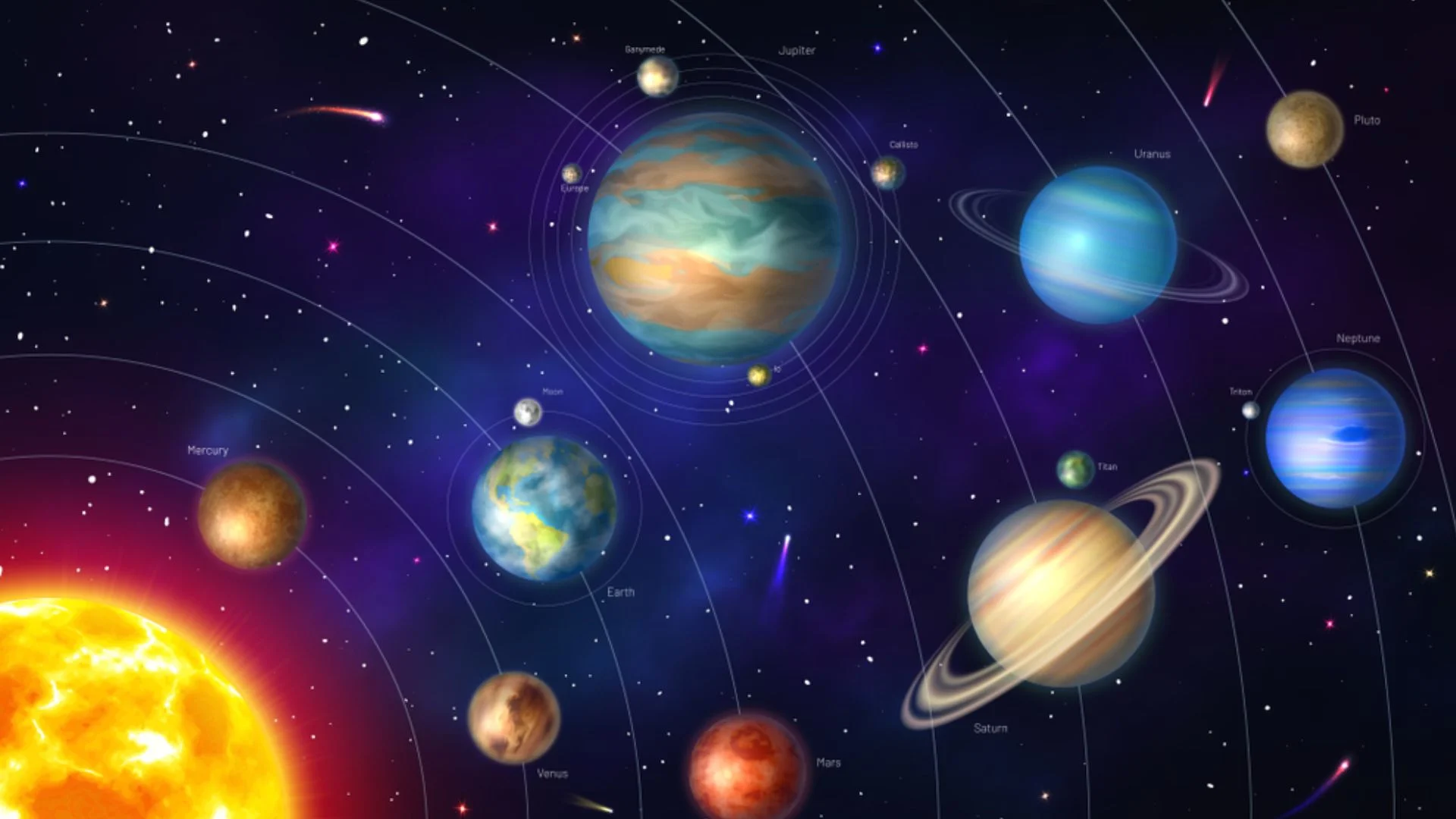
The eight planets in our solar system, in order from the Sun, are:
- Mercury
- Venus
- Earth
- Mars
- Jupiter
- Saturn
- Uranus
- Neptune
Before 2006, the answer was 9 planets. The ninth one was Pluto. But Pluto was officially removed from the list of planets and reclassified as a dwarf planet.
Pluto was reclassified as a dwarf planet in 2006 by the International Astronomical Union because other objects might cross its orbit.
NASA
What is a Planet?
Before we go deeper into each planet, it is important to understand what makes something a planet. This is actually the question that changed everything in 2006.
Before 2006, there was no official scientific definition of the word “planet.” Scientists used the word loosely, the way we use the word “big” without having an exact rule for it. But as telescopes became more powerful and more space objects were discovered, scientists realised they needed a clear definition.
In August 2006, the International Astronomical Union (IAU), which is the official body responsible for naming and classifying objects in space, held a vote in Prague, Czech Republic. They came up with three conditions that any object must satisfy to be called a planet as mentioned by NASA:
Condition 1: It must orbit the Sun.
Condition 2: It must have enough mass (or size) so that its own gravity pulls it into a nearly round shape.
Condition 3: It must have “cleared the neighbourhood” around its orbit. This means it must be the dominant object in its region of space, with no other similar-sized bodies sharing its orbital path, except its own moons.
If an object meets only the first two conditions but not the third, it is called a dwarf planet and not a full planet. That is why Pluto lost its planet status.
Planets of Our Solar System
1. Mercury
Source: NASA
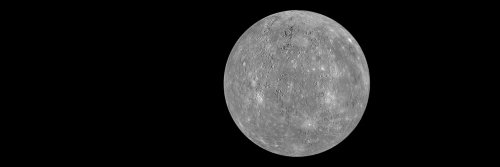
Mercury is the smallest planet in our solar system and the closest to the Sun, sitting at a distance of about 58 million kilometres. Because it is so close to the Sun, it completes one full orbit in just 88 Earth days, making it the fastest planet in terms of its journey around the Sun.
But here is something that surprises most people: even though Mercury is the closest planet to the Sun, it is not the hottest planet. Because it has almost no atmosphere to trap heat, temperatures on Mercury can go as high as 430 degrees Celsius during the day and drop to minus 180 degrees Celsius at night. Mercury has no moons.
Mercury’s surface temperatures are both extremely hot and cold. Because the planet is so close to the Sun, day temperatures can reach highs of 800°F (430°C). Without an atmosphere to retain that heat at night, temperatures can dip as low as -290°F (-180°C).
NASA
2. Venus
Source: NASA
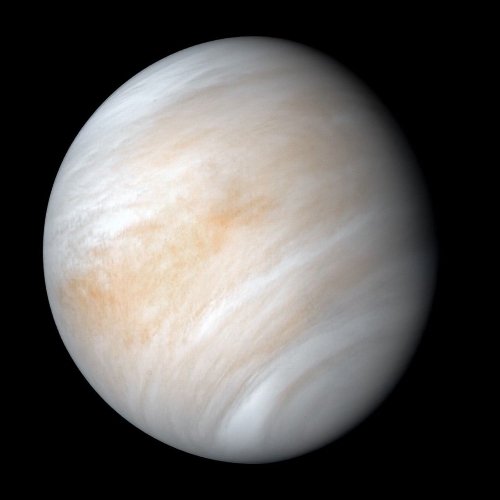
Venus is the second planet from the Sun and is often called Earth’s twin because it is almost the same size as our planet. But that is where the similarity ends.
Venus is the hottest planet in our solar system, with surface temperatures reaching over 460 degrees Celsius, which is hot enough to melt lead. This is because Venus has a very thick atmosphere made mostly of carbon dioxide, which traps the Sun’s heat and never lets it escape. This is called the greenhouse effect.
Venus is similar in structure and size to Earth, and is sometimes called Earth’s evil twin. Its thick atmosphere traps heat in a runaway greenhouse effect, making it the hottest planet in our solar system with surface temperatures hot enough to melt lead — about 872 degrees Fahrenheit (467 Celsius). And the atmospheric pressure at the surface is about 93 times what it is at sea level on Earth. Below Venus’ dense, persistent clouds, the surface has volcanoes and deformed mountains.
NASA
Venus also spins in the opposite direction compared to most planets. So on Venus, the Sun rises in the west and sets in the east. It has no moons.
3. Earth
Source: NASA Science
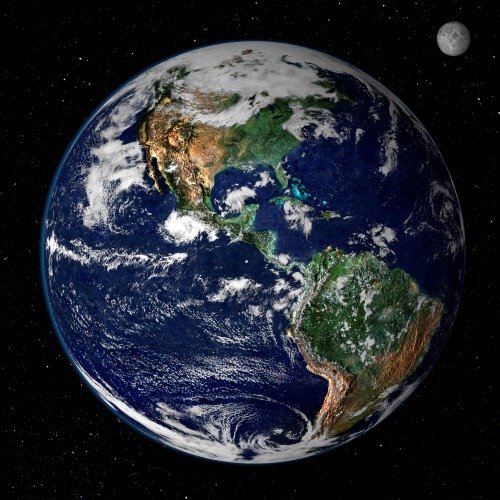
Earth is the third planet from the Sun and the only known planet in the entire universe where life exists. Earth sits at the perfect distance from the Sun, about 150 million kilometres, placing it in what scientists call the “Goldilocks Zone” or the habitable zone. This is the zone where it is neither too hot nor too cold for liquid water to exist on the surface.
Earth has one natural satellite, which is our Moon. The Moon helps stabilise Earth’s tilt and is responsible for the tides in our oceans.
4. Mars
Source: NASA Science
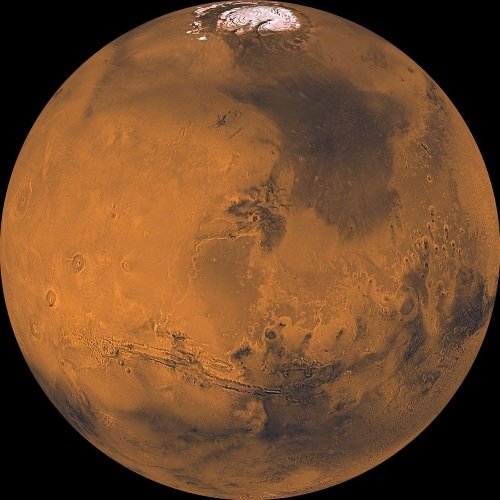
Mars is the fourth planet from the Sun and is famously called the Red Planet because its surface is covered in iron oxide, which is basically rust. This gives it a reddish colour that is visible even from Earth on clear nights.
Mars is home to Olympus Mons which is the largest volcano in the entire solar system, about three times taller than Mount Everest. It also has the longest and deepest canyon system in the solar system called Valles Marineris, which stretches over 4,000 kilometres.
Mars is home to the largest volcano in the solar system, Olympus Mons. It dwarfs Earth’s highest peak, Mount Everest, which rises 29,029 feet, or 8,848 meters, above the Earth’s surface. Olympus Mons stands more than 25 miles (that’s more than 132,000 feet, or 40 kilometers) tall from base to summit, with the base covering an area as large as the state of Arizona
NASA
Mars has two small moons named Phobos and Deimos. Scientists believe that Mars may have once had liquid water on its surface, and space agencies including NASA and ISRO are actively studying the possibility of past or present microbial life on the planet.
5. Jupiter
Source: NASA
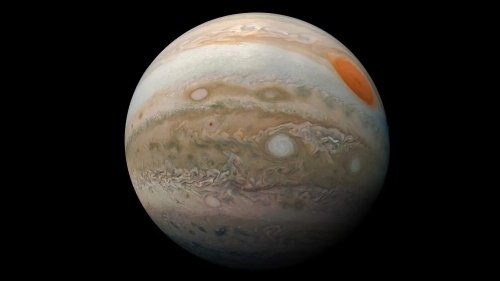
Jupiter is the fifth planet from the Sun and the largest planet in our solar system. It is so massive that more than 1,000 Earths could fit inside it. Jupiter is a gas giant, meaning it does not have a solid surface. It is made mostly of hydrogen and helium.
Jupiter is a world of extremes. It’s the largest planet in our solar system – if it were a hollow shell, 1,000 Earths could fit inside. It’s also the oldest planet, forming from the dust and gases left over from the Sun’s formation 4.6 billion years ago.
NASA
Jupiter is famous for its Great Red Spot, a giant storm that has been raging on its surface for hundreds of years and is larger than the entire Earth. Jupiter has at least 95 known moons, the most of any planet.
NASA mentions: “Jupiter has 95 moons that are officially recognized by the International Astronomical Union.”
Jupiter also plays a very important protective role for Earth. Its massive gravitational pull traps many asteroids and comets that might otherwise head towards the inner planets, including our own.
6. Saturn
Source: NASA
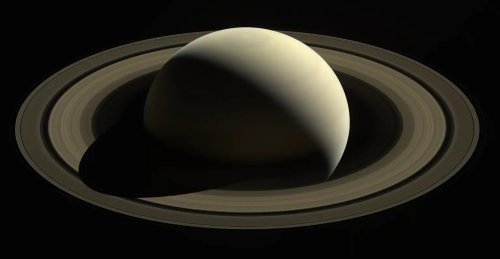
Saturn is the sixth planet from the Sun and is without doubt the most visually stunning planet in our solar system, thanks to its spectacular ring system. These rings are made of billions of pieces of ice, rock, and dust, and they stretch out for hundreds of thousands of kilometres around the planet.
Saturn is the sixth planet from the Sun, and the second-largest planet in our solar system
NASA
Saturn is the second largest planet in the solar system and is also a gas giant. Despite its enormous size, Saturn is the least dense planet, meaning it would actually float if you could place it in a large enough ocean.
7. Uranus
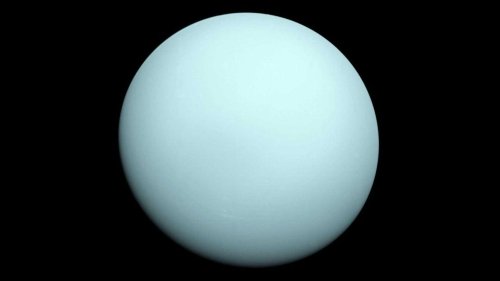
Source: NASA
Uranus is the seventh planet from the Sun and is classified as an ice giant. What makes Uranus truly one of a kind is the fact that it rotates on its side.
Uranus was the first planet to be discovered using a telescope, by astronomer William Herschel in 1781. It is also the coldest planet in the solar system, with temperatures dropping as low as minus 224 degrees Celsius.
Uranus was the first planet found with the aid of a telescope. It was discovered in 1781 by astronomer William Herschel, although he originally thought it was either a comet or a star. It was two years later that the object was universally accepted as a new planet, in part because of observations by astronomer Johann Elert Bode.
NASA
Its moons are uniquely named after characters from the literary works of William Shakespeare and Alexander Pope, unlike the Greek and Roman mythology names used for other moons.
8. Neptune
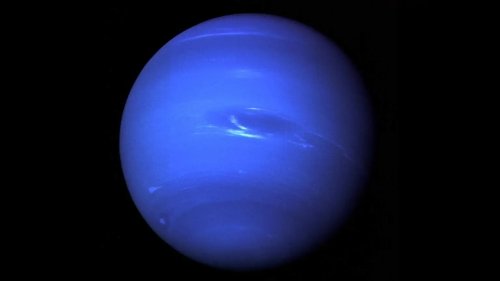
Source: NASA
Neptune is the eighth and farthest planet from the Sun, sitting at a distance of about 450 crore kilometres. It is also an ice giant, similar in composition to Uranus.
Neptune is known for having the fastest winds in the solar system. It has a massive storm called the Great Dark Spot, which is similar to Jupiter’s Great Red Spot. Neptune has 16 known moons, the largest of which is Triton. What makes Triton unique is that it orbits Neptune in the opposite direction of the planet’s rotation, which is extremely rare in our solar system.
In 1989 a large, oval-shaped storm in Neptune’s southern hemisphere dubbed the “Great Dark Spot” was large enough to contain the entire Earth. That storm has since disappeared, but new ones have appeared on different parts of the planet.
NASA
Neptune takes about 165 Earth years to complete just one orbit around the Sun. It was also the first planet to be discovered through mathematical calculations rather than direct observation.
What Happened to Pluto?
This is easily the most talked-about question in all of space science, and for good reason. Most Indians who studied science before 2006 grew up with nine planets. Then one day, the count changed to eight. So what exactly happened to Pluto?
The Discovery of Pluto
Pluto was discovered on 18 February 1930 by American astronomer Clyde Tombaugh at the Lowell Observatory in Flagstaff, Arizona. It was considered the ninth planet of our solar system for 76 years. The name “Pluto” was suggested by an 11-year-old British girl named Venetia Burney, who named it after the Roman god of the underworld.
The Problem That Changed Everything
For decades, everything was fine. But as telescopes became more powerful, astronomers started discovering more and more Pluto-sized objects in a distant region of our solar system called the Kuiper Belt, which lies beyond the orbit of Neptune. The Kuiper Belt is full of icy objects, and many of them turned out to be almost as big as Pluto.
The real turning point came in 2005, when astronomer Mike Brown and his team discovered an object called Eris, which was found to be roughly the same size as Pluto but with even more mass. This discovery caused a serious problem for scientists. If Pluto was a planet, then Eris had to be one too. And if Eris was a planet, then dozens of other similar objects in the Kuiper Belt would also have to be called planets. The solar system could have had hundreds of planets.
NASA states: “The discovery of Eris help trigger a debate in the scientific community that led to the International Astronomical Union’s decision in 2006 to clarify the definition of a planet. Pluto, Eris, and other similar objects are now classified as dwarf planets. Eris was discovered on Jan. 5, 2005, from data obtained on Oct. 21, 2003, during a Palomar Observatory survey of the outer solar system by Mike Brown, a professor of planetary astronomy at the California Institute of Technology; Chad Trujillo of the Gemini Observatory; and David Rabinowitz of Yale University.”
Dwarf Planets in Our Solar System
Along with Pluto, the IAU officially recognises 5 dwarf planets. Here is the list as per NASA:
- Ceres
- Pluto
- Eris
- Haumea
- Makemake
There are 8 planets in our solar system: Mercury, Venus, Earth, Mars, Jupiter, Saturn, Uranus, and Neptune. The change from 9 to 8 happened in 2006 when the International Astronomical Union redefined the word “planet” and reclassified Pluto as a dwarf planet.
Each of these 8 planets is unique in its own way. From Mercury, which is barely bigger than our Moon, to Jupiter, the giant that protects our inner solar system, to Saturn with its breathtaking rings, every planet has something extraordinary to offer.
Space science is always evolving. What we know today may be updated tomorrow as new discoveries are made. The story of Pluto is the perfect example of how science keeps questioning itself and getting better over time. And that is exactly what makes it so exciting.
READ| Who Discovered Radioactivity?
For more such well-researched GK articles helpful for exam aspirants and general readers seeking authentic and up-to-date coverage of current affairs, history, polity, science, technology, economy, sports, and beyond, keep exploring various categories of GKinfoBuzz, your trusted resource for knowledge and information.